
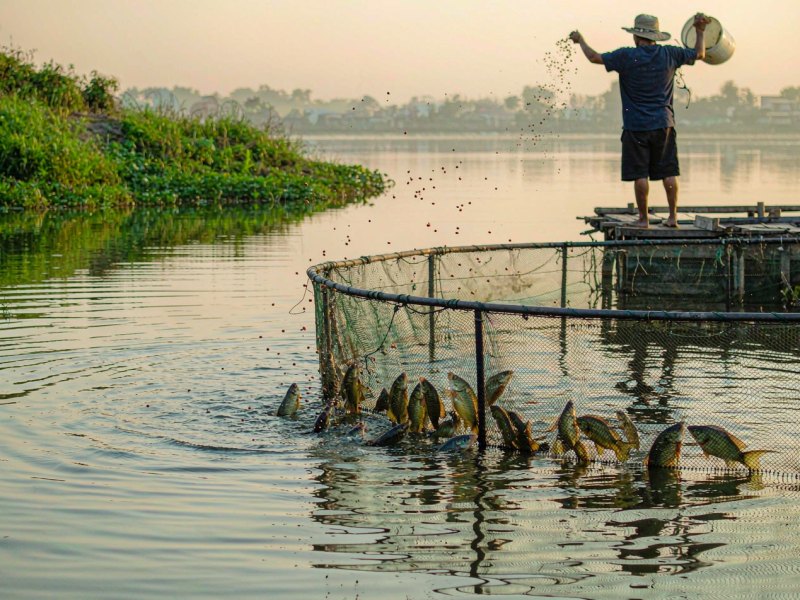
In tilapia farming, feed decides profit. Ask any producer in Ghana, Nigeria or Cote d'Ivoire what separates a profitable cage from a loss-making one, and the answer is rarely the farmgate price of fish. It is the feed conversion ratio, the kilogrammes of feed needed to grow one kilogramme of fish. With feed taking sixty to seventy per cent of production cost, an improvement of just 0.2 in the FCR is worth more than any price negotiation at harvest. So how can a West African fish farmer reduce feed cost without slowing growth? Seven field-tested steps follow.
Buy the right pellet, not the cheapest one
Sinking feed that vanishes into the mud makes it impossible to see how much the fish are really eating. Good quality floating pellets of a size matched to the fish, about two millimetre crumbles for fingerlings and four to six millimetre pellets for grow-out above one hundred and fifty grammes, waste less and let you manage every meal by eye. A slightly dearer pellet that improves the FCR is almost always cheaper per kilogramme of fish grown.
Feed by a rate table and adjust every week
Estimate the standing biomass by sampling fish from at least three points each week, then feed two to three per cent of that biomass per day for grow-out fish, split into two or three meals. Hand feeding against a fixed scoop leads to chronic overfeeding, the single most common cause of a poor FCR on small farms.
Stop before the fish are full
Tilapia eat fast in the first minutes and slow down as they approach satiation. The last portion of a meal is the least efficient, because digestion and activity rise while the extra intake no longer converts to growth. Watch the feeding response and lift out remaining feed once the frenzy calms.
Guard dissolved oxygen
Appetite collapses when dissolved oxygen falls below roughly three milligrammes per litre, and feed eaten at low oxygen converts poorly. Avoid overstocking, exchange or aerate water in the hottest weeks, and skip a meal on hot, windless afternoons when fish gulp at the surface. Feed that is never eaten is a pure loss.
Balance the formula instead of pushing protein
Grow-out tilapia perform well on twenty-eight to thirty per cent crude protein when the amino acid profile is right. Excess protein is burned as energy, an expensive way to heat water. Check lysine and methionine levels, use a complete vitamin and mineral premix, and consider digestive additives such as enzymes or probiotics that pay back through a better FCR.
Use local by-products with care
Rice bran, maize offals and cassava products can cut feed cost when grain prices spike, but they are low in protein and poorly balanced in amino acids. Blend them into a properly formulated ration rather than replacing a commercial feed one for one, and test the result on a few cages before committing the whole farm.
Record everything
Weigh feed into and out of every pond and cage, record mortalities and escapes, and calculate the FCR of each batch. Farms that keep records routinely discover that theft, leaks through damaged nets and unrecorded deaths, not nutrition, explain most of their apparent feed waste.
Put together, these steps regularly move a farm from an FCR above two to about one point six without new equipment. Premix quality is part of that equation, and our team supports fish feed producers across West Africa with vitamin and trace mineral premixes designed for warm-water species. Reach us on WhatsApp to discuss your formula.