
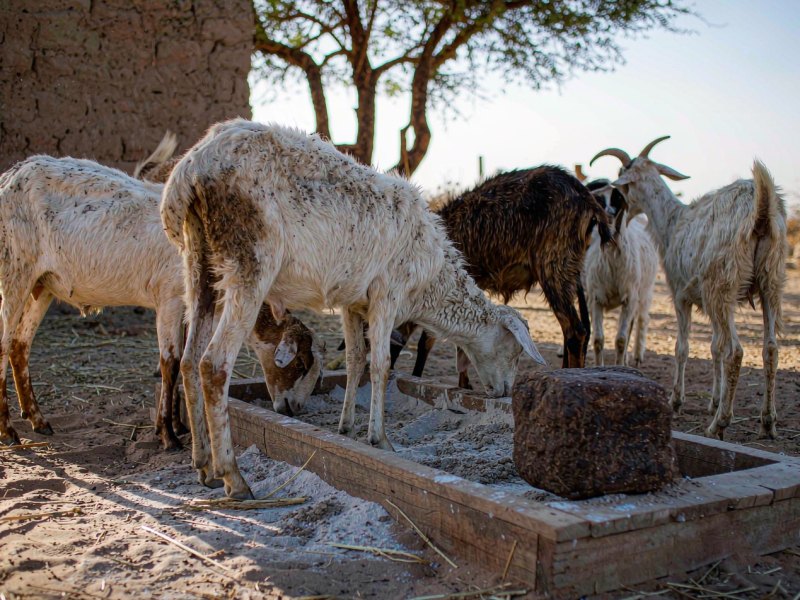
Ask a sheep farmer in Kano or Kaolack whether his animals get minerals and the answer is usually the same, there is a salt lick in the pen. Salt is useful, but it is only sodium and chloride. A mineral premix carries the seven or eight elements that decide whether a lamb grows, whether a ewe holds her pregnancy and whether hooves stay sound through the wet season. So do sheep and goats really need mineral supplements, or is the salt block enough? In most West African systems the block covers perhaps a fifth of the requirement.
What the salt block does and does not do
Sodium and chloride drive water balance and appetite, and animals will walk a long way for salt. What the block does not supply is selenium, cobalt, copper, zinc, iodine, manganese or the correct balance of calcium and phosphorus. These are needed in milligrams rather than kilograms, which is exactly why a deficiency is easy to miss until production drops. Forage samples across the region show the same pattern, sandy soils and long dry seasons produce roughage that is low in phosphorus, copper and zinc, while lush grass in the rains can be low in magnesium and high in potassium.
The deficiencies that cost money
A selenium shortage shows up as stiff, reluctant lambs, in severe cases as white muscle disease, and it also weakens the immune response to vaccination. Cobalt is used by rumen bacteria to make vitamin B12, so a shortage looks like poor growth, pale membranes and a rough coat rather than a classic disease. Zinc governs hoof horn and skin healing, and a shortfall is often blamed on footrot when the real cause is the ration. Iodine affects the thyroid and can show as goitre in kids. Copper is the mineral that needs care, sheep require only about five to ten milligrams per kilogram of dry matter and can be poisoned above roughly fifteen, so a goat mineral must never be fed to sheep, because goats tolerate two to three times more copper than sheep do.
Calcium, phosphorus and the dry season
The calcium to phosphorus ratio should sit near two to one. Dry season roughage such as cereal straw is low in phosphorus, and millet or sorghum stover can be worse, so a phosphorus source in the mineral mix matters more in March than in September. Where cottonseed or groundnut cake is also fed, the calcium side needs attention, because those cakes are heavy in phosphorus.
Feeding minerals so they are actually eaten
Loose mineral in a covered trough beats a block in almost every trial, intake is more even and you can see what has been used. Expect roughly ten to twenty grams per head per day for sheep and goats, weigh what you put out and adjust. Keep the trough in shade with drainage holes so rain does not set the mix into a stone, place it away from the water point so animals do not drink and walk off, and never stir mineral into a hot wet mash, because the vitamins in a premix degrade within hours. For farms mixing their own concentrate, a sheep or goat premix at 0.5 to 1 per cent of the ration delivers the same minerals with far less labour.
If you are reviewing your mineral programme before the dry season, our technical team can look at your forage and your ration and suggest an inclusion rate. Send us a message on WhatsApp for a formulation sheet.