
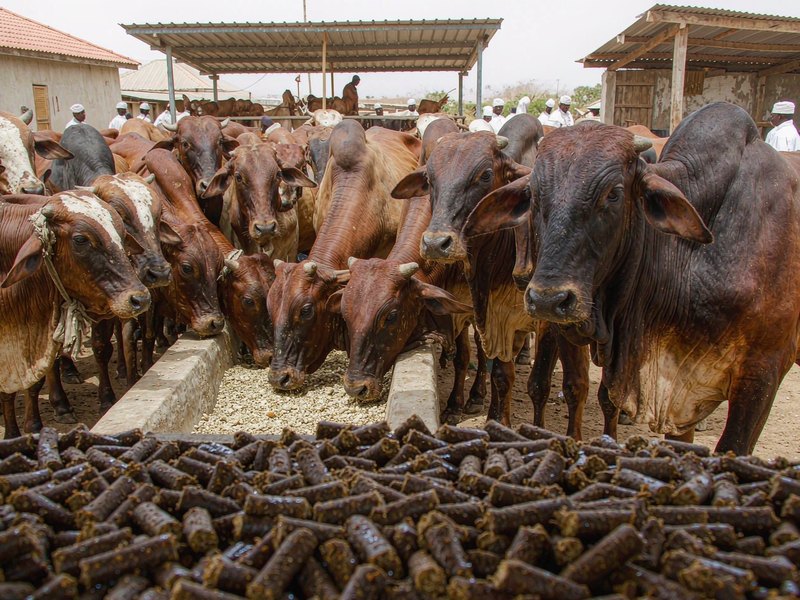
For decades, cattle feeding in West Africa was mostly a question of grazing, crop residues and whatever concentrate a farmer could mix by hand. That picture is changing fast, and the latest sign comes from Nigeria. On September tenth, agribusiness group Olam Agri launched a commercial cattle feed range called Tru Value at an event in Kaduna State, attended by Nigeria's Minister of Livestock Development, Idi Mukhtar Maiha. For anyone watching the region's livestock economy, the move is worth reading closely.
The new range covers three products aimed at the two main ruminant businesses. Tru Value Beef Pellet is designed for efficient weight gain and shorter fattening cycles. Tru Value Beef Plus Pellet targets accelerated growth and finishing performance, the phase that decides carcass value at slaughter. Tru Value Dairy Pellet is formulated to raise milk yield and overall herd productivity. The company, which already produces poultry and aquaculture feed in Nigeria, says the range is built to deliver consistent, balanced nutrition in every bag, addressing complaints farmers commonly raise about traditional feeding, namely inconsistency and unreliable supply.
Why does this matter beyond Nigeria? Because the entry of a large industrial producer into ruminant feed is a signal about where demand is heading. Nigeria is one of Africa's largest livestock markets, and its government has been pushing hard to modernise the sector, from the new Ministry of Livestock Development to the national feed and fodder policy work currently under way. When a company of this size invests in cattle pellets, it is betting that commercial fattening and dairy farming will keep growing and that farmers will pay for predictable performance.
For beef farmers and feed buyers across West Africa, the trend carries practical lessons. First, pelleted compound feed is no longer exotic for ruminants. Where it is available, it allows precise control of energy and protein during fattening, which is exactly what determines daily gain and feed conversion. Farmers comparing options should ask suppliers for the analysed composition and the recommended daily allowance per animal, then judge results by weighing animals rather than by eyeballing them.
Second, price per bag is not the same as cost per kilogram of gain. A cheaper mix that lacks consistent nutrient levels often extends the fattening cycle and quietly eats the margin. As commercial ranges spread, farmers gain a benchmark against which to compare their own home mixing, including the true cost of premix, protein sources and milling.
Third, competition is good news for buyers. More producers entering cattle feed usually means wider distribution, better technical support and eventually sharper prices. Farmers in neighbouring countries should watch how these products move across borders and how importers and local millers respond.
None of this replaces good roughage, clean water, herd health and sound records. Commercial concentrate is one component of a fattening programme, not a magic substitute for management. But the direction of travel is clear. Ruminant farming in West Africa is professionalising, and nutrition is where the money is being made or lost.
Jinmao Biotech has been supplying vitamin and mineral premixes for livestock feed producers across West Africa since 2018, including premixes used in cattle and sheep fattening feeds. If you are a feed miller or a large farm planning your own ruminant feed line, our technical team can help you design a formula that fits local raw materials. Contact us on WhatsApp to discuss your requirements.