
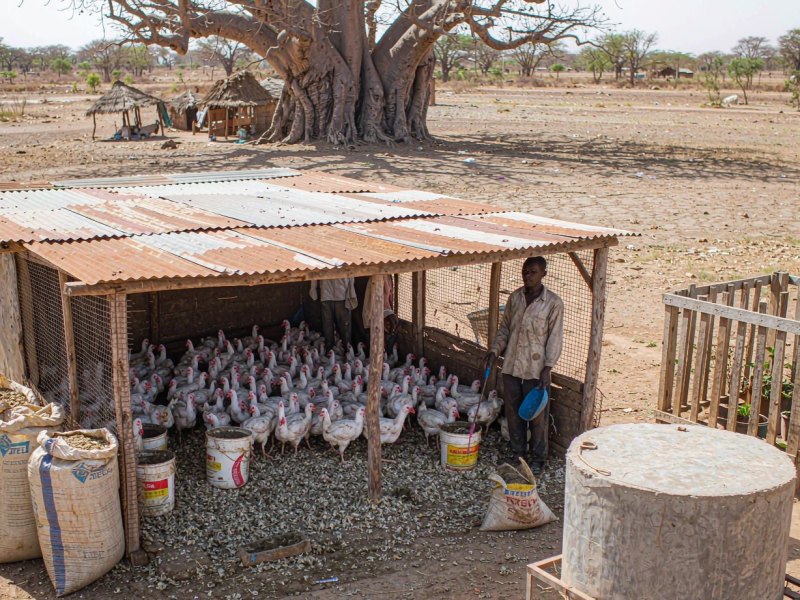
Poultry farmers in three northern Nigerian states are cutting flock sizes or closing altogether, according to a News Agency of Nigeria report published on 20 October and carried by eFeedLink two days later. The detail that matters is not that feed is expensive. It is that feed has become slightly cheaper and farms are still closing. Why are poultry farms closing in northern Nigeria when the price of a bag has fallen? Because the problem has moved from the cost side of the ledger to the demand side.
In Bauchi, Gombe and Jigawa, a 25 kg bag of feed sells for between 20,000 and 23,000 naira, roughly 13 to 15 US dollars. Margret Yohanna, a farmer in Bauchi, has halved her chick intake from 100 to 50 birds, and puts the cost of feeding one chick from starter to finisher at about 8,000 naira, close to 5 dollars. In Dutse, feed dealer Aliyu Hamza said the same bag now sells for 20,000 to 22,000 naira, down from 24,000, and he attributes the fall to weaker demand, not cheaper raw material.
On the selling side the picture is worse. Sunusi Abdu of the Jigawa State Poultry Sellers Association said daily sales have dropped from about 150 birds to about 60. In Gombe, farmer Florence John estimates that 30 to 40 per cent of the poultry farmers in her community have closed because they cannot afford feed and vaccines. Farmers in all three states asked for loans, grants, subsidies and support for local feed production.
This is not a price spike story. A separate briefing by the Poultry Association of Nigeria, held ahead of the Nigerian Poultry Show on 3 to 5 November in Abeokuta and reported by Punch and The Guardian, put feed at about 75 per cent of poultry production costs and listed day-old chick supply, finance and disease outbreaks alongside it. The same briefing called for agricultural credit at single-digit interest.
For anyone selling premix, additives or compound feed into this market, three things follow. First, a cheaper bag is not a recovery signal. When a dealer cuts his price because volume has collapsed, the value of the whole ration chain is shrinking, and premix inclusion is one of the first line items a pressed miller trims. Expect requests for lower-inclusion formulations. That is exactly where quality control earns its keep, because an under-specified premix produces birds that miss target weight, and the farmer blames the feed.
Second, the closure of 30 to 40 per cent of small farms in one community concentrates demand into fewer and larger buyers. Those buyers negotiate harder and ask for paperwork. A supplier who can produce a specification sheet, a batch number and a consistent analysis will keep the account that survives.
Third, cash is the real constraint, not price per tonne. A farmer who cannot find 8,000 naira to carry one chick to market weight is not going to switch brands over a small difference in price per bag. Smaller pack sizes and staged payment terms do more for volume than a discount does.
For buyers, the practical lesson is to stop comparing bags and start comparing cost per kilogram of live weight or per egg. Two feeds at the same price per bag can differ by 8 to 10 points of feed conversion, worth more than any discount a dealer can offer.
We supply vitamin and mineral premixes and feed additives to mills and farms across West Africa, in pack sizes from 1 kg trial units to 25 kg bags. If you are reformulating to protect margin this season, send your current formula and target species on WhatsApp and we will check the inclusion rates with you before you commit to a purchase.