
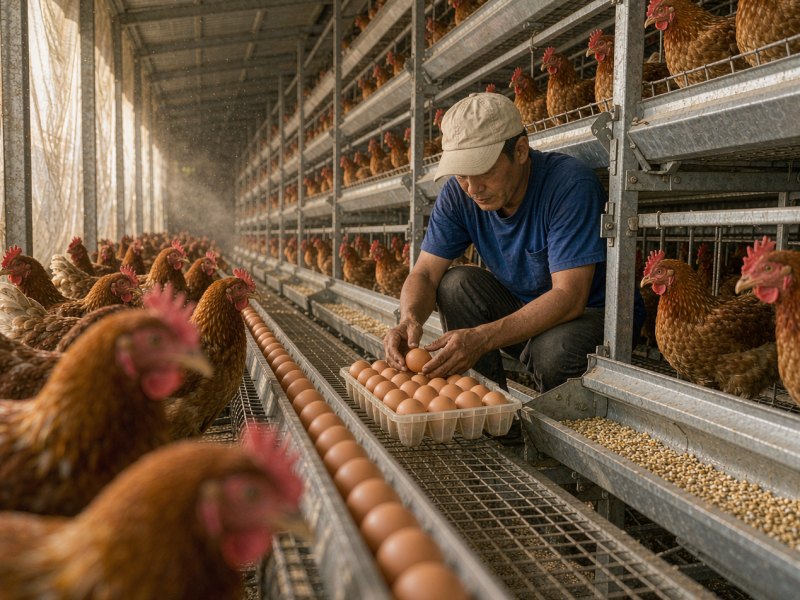
Most layer flocks in West Africa are kept for two cycles, and the second half of the first cycle is where the money is won or lost. Between roughly seventy and one hundred weeks of age a hen still lays, but she lays bigger eggs from the same shell budget, eats more feed per egg and loses body weight faster. Feeding her the ration that worked at thirty weeks is the commonest reason a flock loses persistency in the last five months of lay. So how should layer feed change in late lay?
Egg size rises while shell quality falls
Egg weight keeps climbing until about sixty five weeks, then plateaus. The shell, however, is a fixed quantity of calcium carbonate spread over a growing surface, so the same milligrams of calcium on a bigger egg mean a thinner shell. In late lay the bird also absorbs calcium less efficiently and activates vitamin D3 less readily. The practical answer is not simply more calcium, it is the right particle size. Coarse limestone of two to four millimetres stays in the gizzard overnight and releases calcium while the shell is being built, which is why at least half of the limestone in a late lay ration should be coarse rather than finely ground.
Cut protein before you cut energy
Egg numbers fall in late lay but feed intake tends to rise, so a ration built for peak production overfeeds amino acids and pushes egg size up further, the opposite of what the shell can support. Reducing crude protein from about sixteen and a half per cent to fifteen and a half, with lysine near 0.70 per cent and methionine plus cystine near 0.60 per cent, holds egg numbers without inflating egg weight. Energy should be trimmed gently, around 2,700 to 2,750 kilocalories of metabolisable energy per kilogram, because the hen still needs to maintain her body weight. Never cut both at once, the flock will answer with a moult you did not plan.
The details that decide whether the flock reaches one hundred weeks
Keep calcium between 4.0 and 4.5 per cent and available phosphorus near 0.30 to 0.35 per cent, with phytase at about 500 FTU to release plant phosphorus and reduce costly monocalcium phosphate. Run vitamin D3 toward the upper end of the label range, and check zinc, manganese and copper, which the shell membrane enzymes depend on. Weigh a sample of birds every two weeks, because a loss of more than five per cent of body weight between seventy and ninety weeks means the energy cut went too far. Feed the coarse limestone in the afternoon, when the shell is being calcified. Keep the water lines clean and the water cool, since a bird that drinks less in the heat eats less and lays a paler shell. And decide by ninety weeks whether to moult or to cull, judging by feed cost per egg rather than by egg price alone.
Late lay is where a layer premix earns its place, because the trace mineral and vitamin specification matters more than the protein level. If you are reformulating for the last twenty weeks of lay, send your current ration and flock records to our technical team on WhatsApp and we will review the specification with you.