
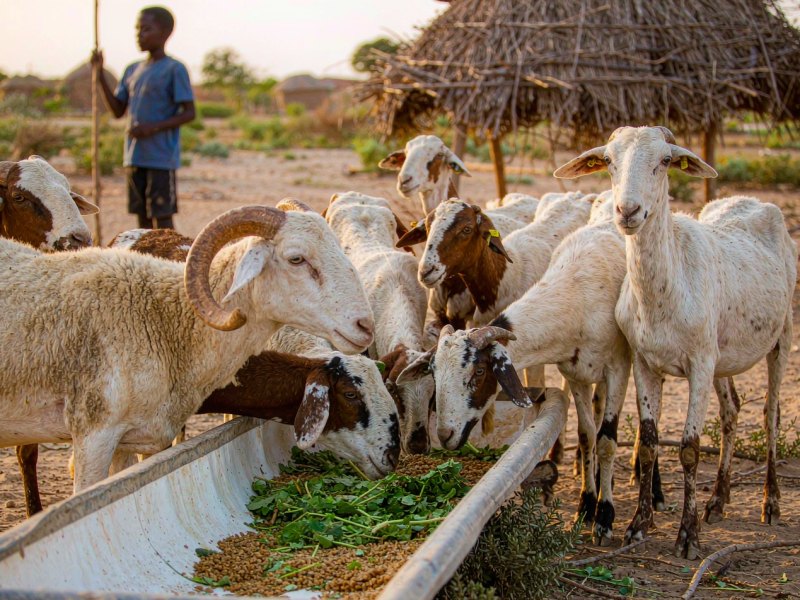
Few periods decide the final value of a sheep as much as the weeks right after weaning. Across West Africa, many farmers lose that opportunity: lambs are weaned, then left to graze whatever they can find, and sold months later at a light weight and a low price. A simple fattening plan of sixty to ninety days after weaning can change that, adding kilogrammes of saleable weight and putting a lamb on the market just before festive demand peaks.
Start with preparation, not feed. Lambs from Sahelian breeds and their crosses are usually weaned between sixty and ninety days of age, ideally at twelve to fifteen kilogrammes. Before fattening begins, drench for internal parasites, especially Haemonchus worms, which thrive in the rainy season and quietly drain blood and appetite. Vaccinate against Peste des Petits Ruminants where this has not been done. Then weigh the lambs and divide them into groups of similar weight, because in a mixed group a few dominant animals always get fat while the rest stay thin.
If you are wondering how to fatten lambs after weaning without expensive imported inputs, the ration itself is straightforward. Aim for a daily gain of 150 to 250 grammes. Give each lamb good roughage such as groundnut haulm, cowpea hay or natural grass hay, and on top of that a concentrate of about 1.5 to 2 percent of body weight per day. A practical concentrate mixes crushed maize or sorghum at 55 to 65 percent, groundnut cake or cottonseed cake at 20 to 25 percent, wheat bran at about 10 percent, and one to two percent of a balanced mineral premix. That brings crude protein to roughly 16 to 18 percent, which young lambs need for muscle and frame growth. Introduce the concentrate over seven to ten days, starting with small amounts, so the rumen adapts and acidosis or bloat does not appear in the first week.
Water and minerals are where many fatteners lose performance. Lambs need clean water at all times, around two to four litres each per day, and more in hot weather. A plain salt block is not enough. Young growing animals need a real mineral premix with calcium, phosphorus, selenium, zinc and cobalt, because deficiencies show up as slow growth, weak bones and poor appetite long before they are visible to the eye.
Management ties it all together. Feed at the same hours twice a day, keep the pen dry and well ventilated, and weigh a sample of lambs every two weeks to check that gains match the plan. Watch for grain overload or bloat, especially after any change of ration. Well managed, Djallonke and crossbred lambs commonly reach 25 to 30 kilogrammes within two to three months of fattening, which is exactly the weight buyers want ahead of Tabaski and other festivals.
Good premixes make a good fattening plan work. Jinmao Biotech supplies sheep and goat premixes and feed additives for West African farms, and we are happy to advise on a ration for your lambs. Contact us on WhatsApp for a recommendation and a quotation.