
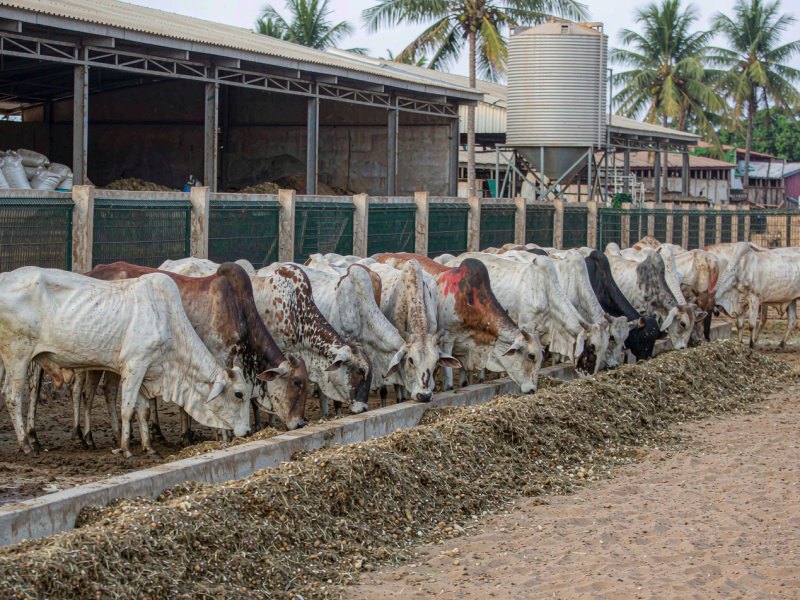
On the sixteenth of October, at the Eko World Food Day celebration in Ikeja, the Lagos State government set out a target that matters to anyone who sells feed. The state wants to move from covering about twenty per cent of its own food demand to forty per cent, and in livestock the headline number is cattle, with a plan to fatten at least one hundred thousand head a year. With more than twenty two million people and very little land, the reasoning is that Lagos cannot expand farmland, so it has to intensify, and intensification means purchased feed.
What was actually announced
The governor, represented by the deputy governor, listed the livestock assets behind the target. A cattle feedlot project at Igbodu in Epe, a pilot dairy farm at Yafin in Badagry where fresh milk production has already started, and the Lagos Aquaculture Centre of Excellence, also in Epe, built under a public private partnership with a hatchery, a feed mill and a processing plant. The centre is projected to produce fifty million fish fingerlings, two thousand tonnes of fish and twenty four thousand tonnes of aquaculture feed a year. The state also put the Imota rice mill at about two and a half million fifty kilogramme bags annually, and described a five year roadmap built on infrastructure and markets, production and processing, people and skills, and innovation with farmer support.
What one hundred thousand head means in tonnes
Do the arithmetic before planning capacity. A fattening animal entering at two hundred and fifty kilogrammes and leaving near four hundred over roughly one hundred days will eat close to eight kilogrammes of dry matter a day, or eight hundred kilogrammes across the cycle. Multiply by one hundred thousand head and the programme implies something in the order of eighty thousand tonnes of feed dry matter a year, of which perhaps a third to a half is concentrate. That is a planning estimate and not a procurement figure, but the order of magnitude is what matters, it is a market that did not exist at this scale in the south west a few years ago.
Where the technical risk sits
Feedlot cattle on high concentrate diets are the classic setting for rumen acidosis, and animals arriving from the north are often tired, dusty and carrying a parasite load. The feed that works in that system is not simply the cheapest per bag, it is a ration with a controlled step up in concentrate, effective fibre, a buffer where the starch load is high, live yeast to steady the rumen, and a mineral premix formulated for gain rather than for maintenance. Buyers who have been caught by a premix with poor mixing uniformity know how expensive inconsistency becomes when a thousand animals eat from the same trough.
What suppliers should prepare now
Three practical steps. First, write a fattening premix specification with the calcium to phosphorus ratio and trace element levels on paper, so that a tender can be answered in documents rather than in conversation. Second, build the logistics case for Epe and Badagry, because a feedlot cannot store six months of premix in coastal humidity and will want frequent, small, dry deliveries. Third, get the paperwork right, batch numbers, certificate of analysis and a stable formulation, since state linked projects increasingly ask for traceability before they sign.
We supply cattle, sheep and poultry compound premixes to farms and feed mills across West Africa and can share a fattening premix specification for your review. Send us a message on WhatsApp.