
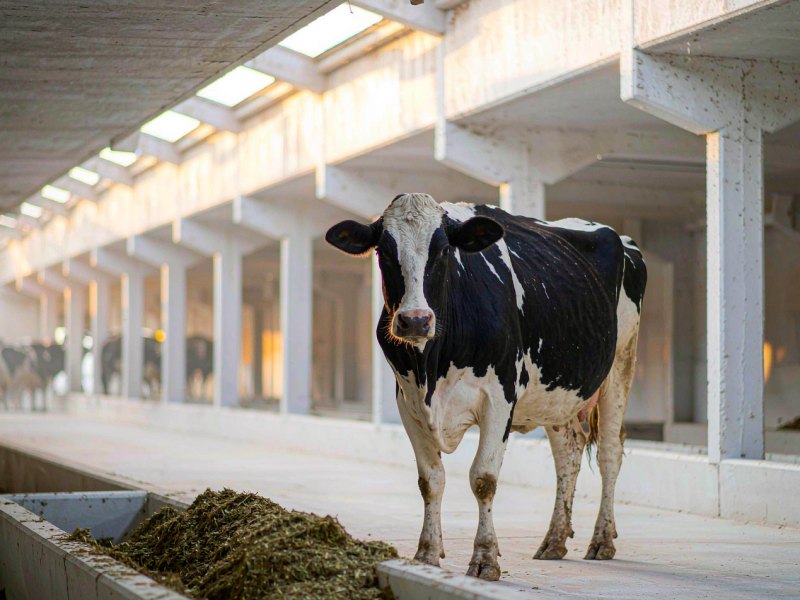
A dairy cow does not start her lactation on the day she calves. She starts it eight weeks earlier, in the dry period, and the way you feed her through those weeks decides how much milk she will give and how quickly she gets back in calf. On many West African farms the cow is simply left on the same ration once she stops milking, or worse, almost starved. Both approaches are costly. The transition from late pregnancy to early lactation is the highest-risk window of the entire cycle, and knowing how to manage the dairy cow transition period is therefore a question every farmer should be able to answer.
Split the dry period into two phases
Plan for roughly sixty days without milking, divided into a far-off phase of five to six weeks and a close-up phase of two to three weeks before calving. In the far-off phase the cow needs maintenance and rumen rest, not fattening. Feed good roughage, keep her at a body condition score of about three to three and a half on the five point scale, and do not push energy. An over-conditioned dry cow mobilises fat after calving, which leads to fatty liver, poor appetite and ketosis. The close-up phase is different. Move her gradually onto the calving group ration so that the rumen papillae stretch and the microbes adapt to higher starch levels before the day she needs them.
Guard against milk fever
Milk fever around calving is one of the most common and most preventable metabolic disorders. It happens when the cow cannot mobilise calcium fast enough for the sudden demand of milk production. In the close-up ration the key is to control dietary potassium, since forages cut from heavily fertilised fields are often very rich in it. Where milk fever keeps recurring, adding anionic salts to lower the dietary cation-anion difference in the last three weeks prepares the cow to mobilise her calcium. Many farms also give an oral calcium supplement at calving to high-risk animals, older cows in particular.
Watch the fresh cow closely
The three weeks after calving decide the lactation. Ration energy density should rise steadily, bulky by-products should give way to better forage, and a dairy premix with correct mineral and vitamin levels becomes critical. Check daily intake, watch for cows that are dull or off feed, and test ketones in urine or milk where ketosis is suspected. Fresh water must be available at all times, because a cow giving thirty litres a day drinks well over one hundred litres. Keep calving pens clean, dry and quiet to protect the udder and the newborn calf.
Small changes, big returns
Transition failures rarely announce themselves. They appear later as retained placenta, displaced abomasum, low peak milk or silent heats. Investing in a proper close-up ration and a well-formulated transition premix costs far less than losing the first hundred days of a lactation. Jinmao Biotech supplies dairy and cattle premixes, feed additives and technical support for farms and feed mills across West Africa. If you want help designing a transition ration for your herd, send us a message on WhatsApp and our team will review your forage base with you.