
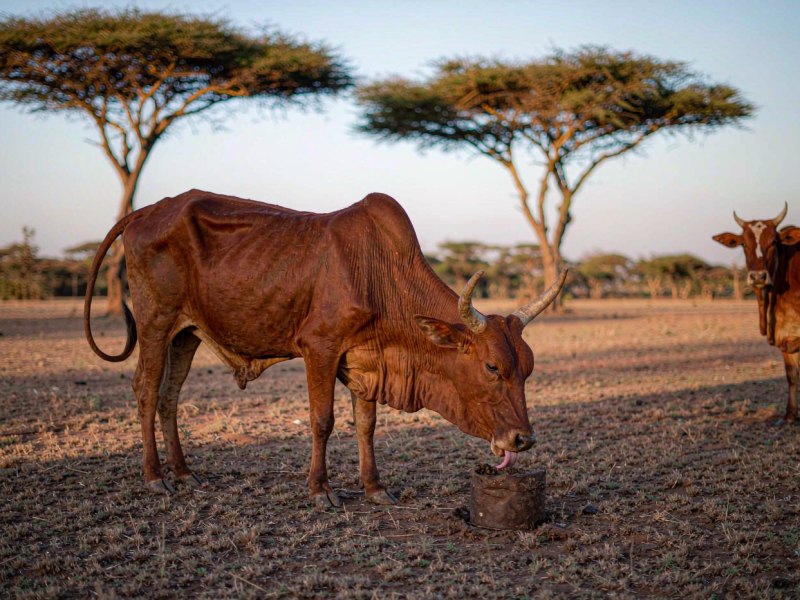
When the rains stop and pasture turns to straw, the cheapest protein for cattle and sheep is not soybean meal but urea, in a hard molasses block that animals can only lick slowly. Rumen microbes turn the nitrogen in urea into their own protein, and the animal harvests those microbes as it digests. A herd on dry savanna grass holding its weight digests roughage far better on a few hundred grams of lick per head per day.
The same block causes more sudden deaths on smallholder farms than any other supplement, almost always when an animal eats too much too fast. Urea releases ammonia faster than microbes can use it, and the excess reaches the blood. The fix is not to avoid blocks but to control access.
Start with block quality. A safe block contains 7 to 10 per cent urea, molasses as binder and attractant, salt, calcium, phosphorus, trace minerals and some sulphur, which rumen microbes need to build amino acids. It must be hard enough that animals can only scrape small amounts off. If you can press a thumb into it, it is a soft block and should not go to unadapted animals, because cattle will bite off chunks and swallow them whole.
An adult cow of 250 to 300 kg should take in no more than 20 to 30 grams of pure urea per day, roughly 250 to 300 grams of a 10 per cent block. Sheep and goats should take 5 to 10 grams of urea. Ewes in late pregnancy need particular care. Calves, lambs and kids under three months have no working rumen and must never reach a urea block, and the same applies to pigs and poultry, for which urea is toxic.
Adaptation matters as much as the block. Introduce blocks at the end of the rains, while animals still have green forage, so the rumen adjusts over two or three weeks. Never give a urea block to animals that have gone without feed for a day or more. A starved animal will gorge, and its rumen has no reserve to dilute the ammonia. Give roughage first, then offer the block.
Daily management is simple. Hang blocks or place them away from water, because animals lick less if the block is not on the way to drink. Provide about one block per five to ten cattle so dominant animals cannot monopolise them. Remove blocks after rain, and never place them where rain collects, since dissolved block becomes a solution animals can drink in dangerous amounts. If your compound feed already contains urea, do not offer blocks as well.
Learn the poisoning signs. They appear within half an hour to two hours of overconsumption: restlessness, salivation, grinding of teeth, a swollen left flank, rapid breathing, trembling and staggering. First aid is vinegar, which acidifies the rumen and binds ammonia: one to two litres of household vinegar diluted in water for an adult cow, and a veterinarian immediately. Prevention through slow access is far cheaper than any cure.
A urea molasses block bridges the worst weeks of the dry season for a few cedis or naira per animal per month. It cannot supply the full mineral and vitamin package, and it does nothing for animals whose base ration lacks energy. A balanced premix built for the local forage base, alongside sound block management, turns a surviving herd into a growing one. Jinmao Biotech supplies premixes for cattle, sheep, goats, pigs and poultry across West Africa, and our team will review your dry-season ration on WhatsApp.