
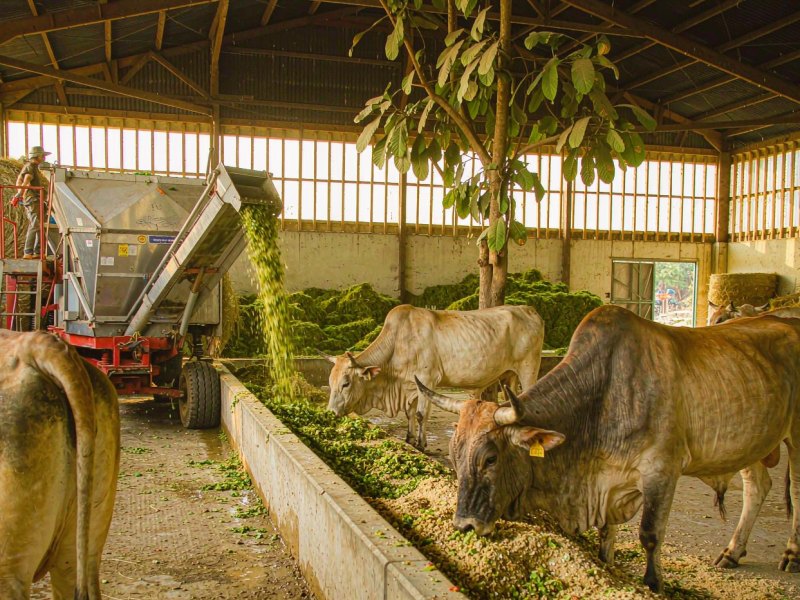
If you are asking why your fattening cattle are not gaining weight evenly, the answer is often in the feed bunk rather than in the ration recipe. This pattern is common on West African fattening farms: the formula looks right, the ingredients are decent, yet a few bulls in the pen gain 1.2 kg per day while the rest drift along at 0.6 kg. One of the most common and least visible causes is uneven mixing, which lets dominant animals sort out the grain and leave the roughage to their pen mates.
When cattle can sort a poorly mixed ration, the strongest animals eat too much concentrate and drift toward rumen acidosis, with loose manure and erratic intake. The weaker animals are left with stems and dust that carry far less energy, so they gain slowly no matter how good the formula looks. The result is a stretched marketing window, uneven slaughter weights and a poor feed conversion ratio.
The simplest way to check mix quality is a shaker box test, often called the Penn State Particle Separator. Deliver a fresh load, then take eight to ten handful samples along the bunk and shake each one through the box. Compare the fractions: the top sieve holds long forage, the middle fraction is digestible fiber and grain, and the bottom pan catches fine particles and premix. If the fractions differ clearly from one sample to the next, your mixer is not doing its job. A well-run mixed ration shows little variation between samples, and commercial farms aim for differences below about five percent.
Mixing discipline matters as much as the machine. Load long forage first, chopped to three to five centimetres, then grains and protein meals, then the small ingredients such as premix, minerals and salt, and pour molasses or water last. Run the mixer three to six minutes after the last ingredient goes in. Under-mixing leaves streaks of mineral and grain, while over-mixing chops the fiber so fine that cattle chew less and the rumen suffers. Keep the mixer to about eighty percent of its rated capacity so every batch turns properly.
Small ingredients deserve special attention. Vitamins, trace minerals and additives enter the ration at very low rates, often below one percent, and a handful dropped into a big mixer will never spread evenly. Use a quality premix that already carries these nutrients on a suitable carrier, and where possible blend the premix with a few kilograms of maize bran before adding it. Check the mixer scales with known weights, because a drifting scale quietly ruins a perfect mixing routine.
Moisture decides how easily cattle can sort. Aim for a total mixed ration around thirty-five to forty-five percent dry matter. In tropical heat, a wet mix sours within hours, so mix only what the pen will eat in a single feeding. Push feed up twice a day and weigh refusals weekly, since rising refusals warn early that the mix has drifted.
Farms without a mixer wagon can still get close. Layer the ingredients on a clean concrete floor, turn the pile three to four times with a shovel, then spread the premix dissolved in water or molasses across the surface and turn once more. Smaller batches mixed longer beat a big batch mixed in a hurry.
Easy, even distribution is exactly why premix design matters. Jinmao Bio cattle premixes are built for low inclusion rates and stable performance in hot climates. Send us your ingredient list on WhatsApp and we will help you review the ration and the mixing routine together.