
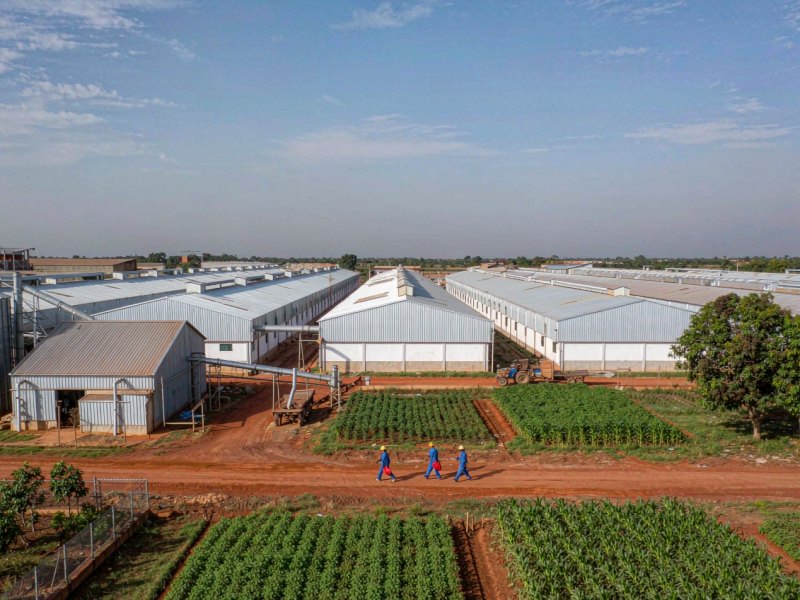
One of West Africa's best known agribusiness success stories is heading into Central Africa. Sedima, the Senegalese poultry group founded in 1976 by Babacar Ngom and led since 2016 by his daughter Anta Babacar Ngom Diack, plans to invest 20.47 billion CFA francs, about 35 million dollars, in an integrated poultry and grain complex at Nkouo in the Pool department of the Republic of Congo, roughly eighty kilometres from Brazzaville. The project, developed through the subsidiary Sedima Congo SA, was reported in early October by trade outlets including Feed Business Middle East and Africa and Poultry News Africa, citing the Congolese business press and the regional daily EcoMatin.
A complete chain, from field to packaged chicken
What makes the project worth watching is its scope. Around six thousand hectares of maize and soybeans would supply a feed plant designed for about 25,000 tonnes of poultry feed a year. A hatchery would produce some 5.25 million hatching eggs, close to 3.29 million day-old chicks and 80,000 pullets annually. Broiler farms and a slaughter and packaging line would finish about 2,200 tonnes of chicken a year for the Congolese market, from grain field to wrapped tray under one owner. Reported production targets include 10,800 tonnes of maize and 6,600 tonnes of soybeans a year.
How the project is being financed
According to the reported financing plan, the Development Bank of Central African States has approved 5 billion CFA francs, with BSCA Bank providing 5.04 billion, BGFIBank 4 billion and LCB Bank 1 billion, a combined 15.04 billion in bank financing. Sedima Congo is expected to put in 5.245 billion of its own funds. Financing is still in progress and no full closing has been announced, so figures should be read as project plans rather than completed commitments.
Why Congo imports so much chicken
The Republic of Congo, like several Central African neighbours, relies heavily on imported frozen chicken and on imported feed inputs priced in dollars. Local production is limited by the cost of feed more than by the cost of birds or barns. That is precisely the gap the integrated model attacks, because growing maize and soybeans next to the feed mill and the farms reduces exposure to world prices and to freight disruption at the same time.
A model proven at home
Sedima is not experimenting. The group built its position in Senegal across nearly five decades on day-old chicks, animal feed, eggs and grain farming, and it already operates beyond Senegal in Mali and Congo. Executives began exploring the Congolese market as early as February 2015, when they met poultry farmers in Pointe-Noire to discuss day-old chick production. The Nkouo complex is described by analysts as the group's largest foreign investment to date.
What it means for the region's feed market
For feed suppliers, the message is that Central African demand for maize, soybeans, premixes and additives is set to grow as more projects copy the integrated playbook. For poultry farms in West Africa, it confirms a trend already visible from Ghana to Nigeria, that whoever controls feed production controls the cost curve of chicken. Jinmao Biotech supplies vitamin and mineral premixes and feed additives to feed producers across West and Central Africa. Contact us on WhatsApp to discuss what our products can do for your operation.