
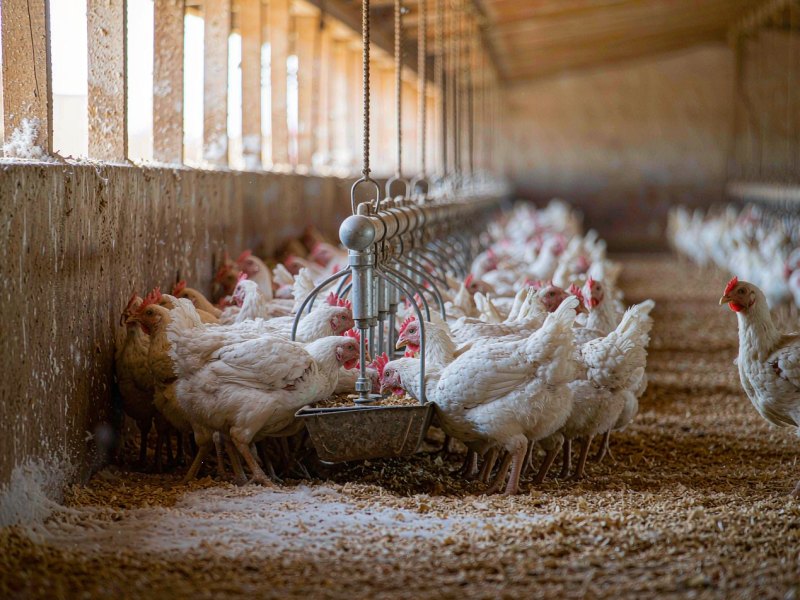
Ask a poultry farmer what drives feed conversion and the answer is usually feed quality, genetics or disease. All three matter, but there is a cheaper input that is forgotten on too many farms: water. A broiler drinks nearly twice as much as it eats over its lifetime, and a layer drinks even more relative to her size. If the water is dirty, warm or loaded with dissolved minerals, no premix or additive will deliver its full value. Water quality quietly decides your feed conversion ratio every single day.
Where water problems start
Most farms in West Africa pump from boreholes, and borehole water often carries a heavy mineral load. Iron gives water a metallic taste and encourages bacterial growth, hardness coats pipes and nipples with scale, and high salinity pushes birds to drink less at exactly the moment hot weather forces them to drink more. The second source of trouble is inside the pipe itself. Every time vitamins, medicines or sugar-based supplements run through a drinker line, a thin film of organic matter is left behind. That film, called biofilm, is a shelter where E. coli, Salmonella and other gut bacteria multiply between flocks. Birds then swallow a dose of bacteria with every sip, and the result appears weeks later as uneven growth, wet droppings and poor litter.
What dirty water costs you
Poor water attacks performance from three directions. First, birds that dislike the taste simply drink less, and a bird that drinks less also eats less, so growth slows and the batch reaches target weight later. Second, minerals and salts loosen droppings, litter turns wet, ammonia rises and footpad and breast problems follow. Third, a constant low-level load of gut bacteria keeps the intestine irritated, nutrients are absorbed less efficiently and the same kilogram of feed yields less meat or fewer eggs. On farms with a real biofilm problem, cleaning the lines alone has visibly lifted performance within one or two flocks.
A practical routine that works
Test the water once a year at the source and once at the end of a drinker line, checking pH, hardness, salinity and bacterial counts. Flush lines between every flock and after every medication or vitamin course, and scrub storage tanks weekly, because a dirty tank undoes everything else. Between flocks, run a descaling product and then sanitise. During production, many farms keep a mild organic acid or a properly dosed chlorine program in the water, which lowers crop pH, makes life difficult for pathogenic bacteria and improves protein digestion. Monitor daily water intake too, because a sudden drop is often the first signal of a health problem, appearing before mortality rises. In hot spells, add electrolytes and vitamins to help birds cope with heat stress, and check drinker height and flow rate so every bird can drink easily.
Nutrition only pays when water is right
A balanced premix and a sound additive program are investments, and clean water is what protects that investment. If you are fighting unexplained feed conversion problems, uneven flocks or wet litter, look at the water before you blame the feed. Our technical team works with farms across West Africa on water-soluble electrolytes, vitamins and gut health additives, and we are glad to review your water and feeding program with you. Reach out on WhatsApp for a practical discussion tailored to your farm.