
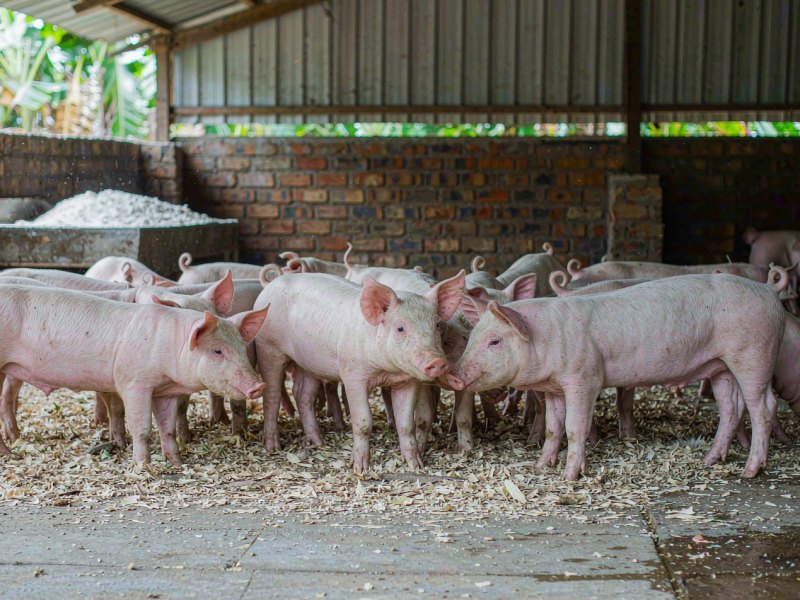
If pigs on your farm are chewing tails, ears or flanks, the first thing to accept is that tail biting is not aggression for its own sake. It is a stress signal, and in most West African grower and finisher units the cause sits in one of three places: the ration, the pen environment, or the health status of the animals. Treating it as a vice and reaching for the knife solves nothing, because the pigs simply redirect the behaviour to ears and flanks.
Start with the feed, because it is the cheapest thing to check. Pigs eating a diet short on crude protein or lysine will look for something to chew. A grower ration below about sixteen percent crude protein, or with lysine under 0.85 percent, is a common finding on farms mixing their own feed with maize and a little soybean meal. Tryptophan matters too, since this amino acid is a precursor of serotonin and a shortage is linked to restless, tail-chewing behaviour. Wheat bran, maize bran and good quality fish meal help, but the reliable route is a balanced premix with a declared amino acid profile.
Salt is the classic culprit and the easiest to fix. Pigs need about 0.4 to 0.5 percent salt in the complete diet. Where salt is added by the handful, or forgotten when a new batch of ingredients arrives, a deficiency develops within weeks and tail biting often follows. Check the label of your concentrate, then check the actual inclusion. Coarse salt should be visible in the mix, not a rumour.
Fibre and minerals complete the picture. A ration that is too concentrated, with no bulk, keeps pigs hungry between meals. Aim for five to seven percent crude fibre in grower feed, using bran, rice hulls or cassava by-products. Zinc, iron, copper and selenium deficiencies worsen skin condition and invite biting at already damaged tails.
Environment comes next, and it is where most chronic cases live. Ammonia above about twenty parts per million irritates eyes and respiratory tract and raises stress. Dust, draughts on one side of the pen, and wide swings between day and night temperature produce the same effect. Floor space below 0.7 square metres per grower pig, one feeder space for more than twelve pigs, or a single nipple for fifteen animals all push competition and biting. Pigs also need something to do. A chain, a rope, a bundle of sisal, a tyre or a handful of sawdust spread twice a day redirects more chewing than any drug.
Look at health and management last, but do not skip them. Mange, lice, diarrhoea, gastric ulcers and lameness all make a pig a target, because pen mates attack animals that behave differently. Mixing unfamiliar groups, abrupt feed changes and feeding times that shift by two hours have the same effect.
A protocol for a pen already biting: walk the pen at feeding time and watch tails rather than faces. Move the worst bitten animals to a hospital pen with soft bedding. Identify and remove the two or three persistent biters, which are usually not the biggest pigs. Lower light intensity for a week. Add enrichment and salt licks. Then correct the ration, and recheck ammonia with a detector tube or a handheld meter.
Prevention pays better than treatment. A pig with a damaged tail loses weight, risks infection and spinal abscess, and is discounted at slaughter. Jinmao Bio pig premixes carry the trace minerals, vitamins and salt support at the correct inclusion rate for grower and finisher diets. Send your current formula on WhatsApp and we will check the mineral and amino acid balance with you.