
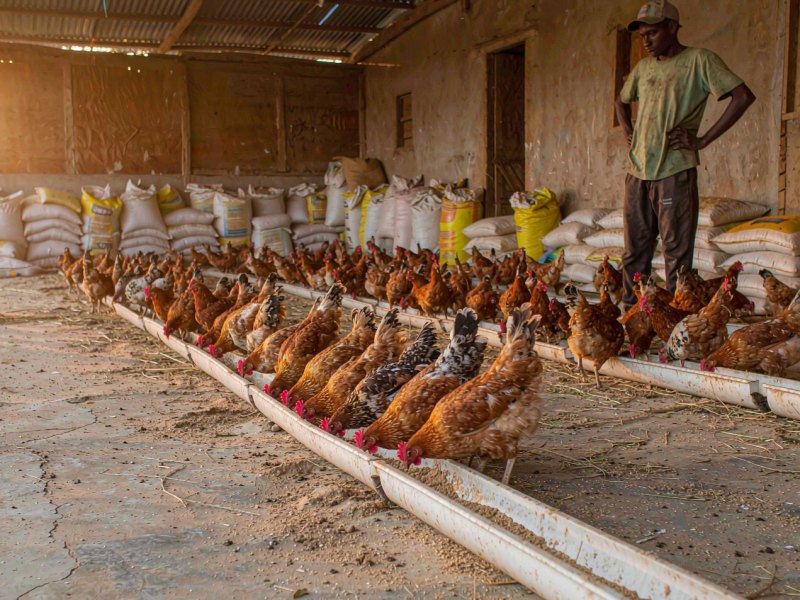
A survey by the News Agency of Nigeria published this week reports that poultry farmers and other livestock keepers in Kebbi, Sokoto and Zamfara states are abandoning their businesses as feed costs keep climbing. The report quotes Dr Abubakar Umar-Bunza, who heads the zonal veterinary clinic in Birnin Kebbi, saying that some small farms in the state have already shut down. For feed buyers across West Africa, the survey is a useful window into how feed economics decide farm survival.
The numbers behind the crisis are stark. Maize makes up about 55 percent of poultry feed, and at its peak a 100 kg bag sold for close to 70,000 naira. Soybeans, the next major ingredient, went above 90,000 naira per 100 kg. The veterinarian also pointed to transport, fertiliser prices and the exchange rate, since some ingredients are imported, alongside insecurity that keeps rural farmers away from their fields and competition between people and animals for grain. Moving 1,200 bags of feed from Kano state, which once cost about 300,000 naira, now costs between 1.2 and 1.5 million naira.
The economics of a small farm show why margins vanish. A day-old broiler chick costs about 2,000 naira, and fifty birds will consume six to seven bags of feed before sale. Farmers selling at 8,000 to 9,000 naira per bird struggle to recover the money once vaccines and labour are counted. In layers, the burden stretches longer, because hens must be fed every day from eight weeks until they start laying at 16 to 20 weeks. Dr Umar-Bunza warned that poor-quality feed weakens immunity and exposes birds to disease, and that mixing in cheaper ingredients lowers egg output, a false economy that comes back as empty nests.
What can buyers and producers do while prices stay high? The survey points to three practical directions. First, cut logistics cost by grouping orders, because transport now exceeds the value of the goods themselves on some routes. Second, protect quality even under pressure, since adulterated or spoiled feed costs more in mortality than it saves in naira. Third, watch the institutional response. Kebbi state is completing a large veterinary hospital at Bulasa with laboratories and artificial insemination facilities, and officials say foreign partners including Brazil have expressed interest in the state livestock sector.
For premix and additive suppliers, the story carries a clear message. When complete feed becomes unaffordable, more farmers shift to home mixing with local grains and a quality premix, and they need honest technical support to get the inclusion rates right. Our team at Jinmao Biotech supplies premixes and feed additives for poultry, pigs and ruminants adapted to West African raw materials, and we are happy to discuss formulations and costs on WhatsApp or by email.