
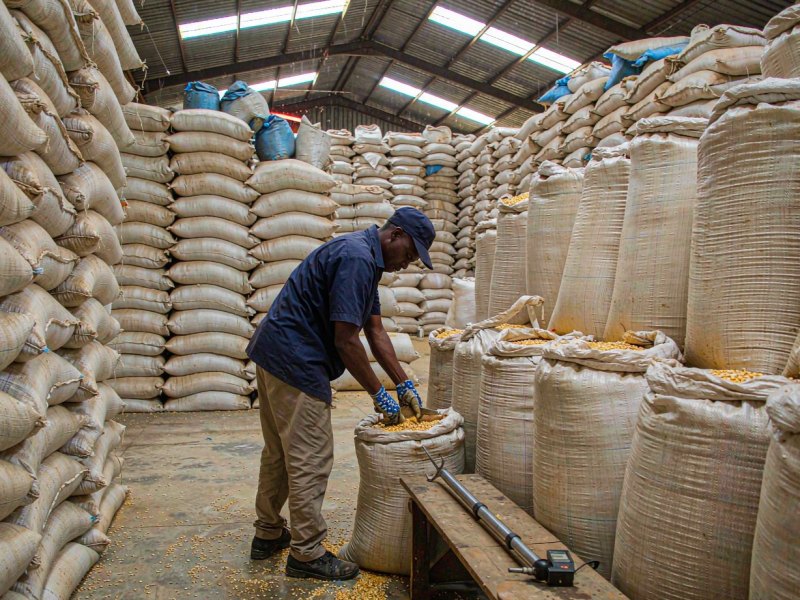
On 8 September 2026 the Bank of Agriculture launched a 200 billion naira Guaranteed Minimum Price programme in Abuja. Farmers who produced maize in the 2025 dry and wet seasons are guaranteed a floor of 350,000 naira per tonne whenever market prices fall below that level. The programme starts with maize, sorghum and soybeans, targets more than 500,000 farmers and plans to aggregate at least 500,000 tonnes. Buying runs through licensed aggregation companies, grain is graded and stored in Nigeria Commodity Exchange warehouses against electronic warehouse receipts, and payment goes directly into farmers' bank accounts with a stated target of 48 hours. The bank was explicit that traders are excluded and that only genuine growers qualify.
There is a second half to the mechanism that matters more for buyers. If maize climbs towards 500,000 naira per tonne, the bank says it can release stored grain back into the market at roughly 380,000 to 390,000 naira per tonne. The programme is therefore not only a floor. It is also an attempt at a ceiling.
Why this reaches your formulation cost. First, a floor sets the bottom of the range you can negotiate. The old harvest strategy of waiting for the glut and buying at the seasonal low now has a cushion under it, because there is a buyer of last resort at 350,000 naira. Budget maize at the floor level, not at the 250,000 to 280,000 naira lows quoted at the launch as the depressed prices of 2024 and 2025, and stress test your feed margin at 390,000 naira.
Second, you will be competing for grain. Aggregation companies are paid per tonne they deliver into the warehouse system, so during the harvest window they will be actively looking for dry, clean, well graded maize in the northern belts, exactly the quality a feed mill wants. Expect quality to command a premium and expect collection points to be busier than usual. Mills that contract directly with farmer groups before the peak of the harvest will spend less than mills that buy spot in January.
Third, the ceiling cuts both ways. A credible release mechanism reduces the case for holding large speculative stocks, because the upside above 500,000 naira is politically capped. But credibility depends on execution, and the history of state grain interventions in the region is mixed on payment speed, truck availability and silo condition. Treat the ceiling as a scenario, not a guarantee, and keep your own cover.
What to do this quarter. Fix your formula cost on a 350,000 naira maize scenario and check what happens at 390,000. Put forward contracts or at least volume commitments in place now, while harvest pressure still weighs on the market. Tighten your intake specification, because graded warehouse receipts will pull the cleanest grain out of the open market and leave the higher moisture and higher aflatoxin lots to buyers who do not test. Keep your substitution levers calibrated, sorghum, cassava and wheat offal, so that a spike does not force a reformulation in a hurry.
One caution on the numbers. 500,000 tonnes is a modest share of national maize output, so this programme will not by itself move the national average. It will move behaviour at the margin, at collection points, in contract terms and in how farmers price their crop at harvest. That is where your buying cost is decided.
We supply vitamin and mineral premixes, toxin binders and feed additives to mills and integrators across West Africa. If you want a cost per tonne comparison for your layer, broiler or ruminant formula under these maize scenarios, send your formulation on WhatsApp and we will run the numbers with you.