
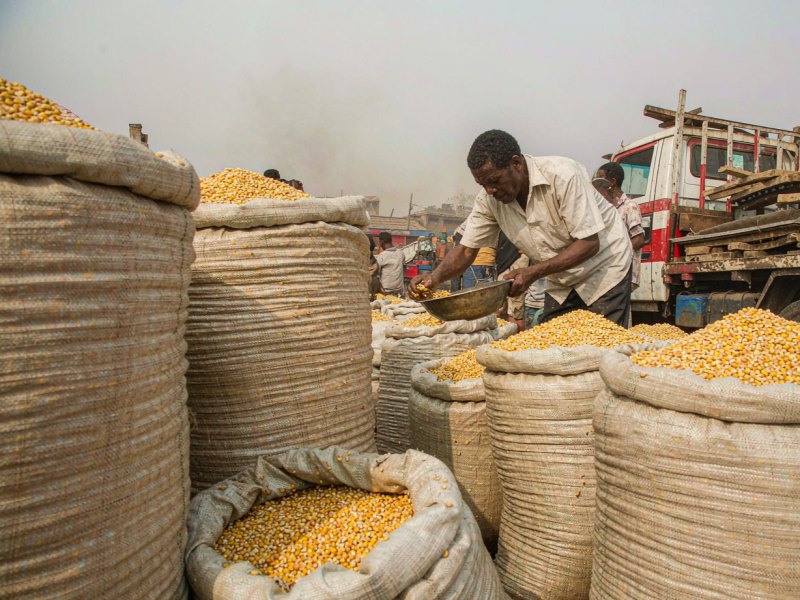
The harvest arrived and maize still went up. Nairametrics published its October market survey on 1 November, covering 67 food staples across the Mushin, Daleko, Mile 12 and Oyingbo markets in Lagos. Thirty one items rose in price, against seventeen in September. Maize was the biggest mover of all. A 50 kg bag of yellow or white maize climbed from 40,000 naira in September to 55,000 naira in October, a 37.5 percent increase in a single month.
Two forces explain it. A grain merchant at Oyingbo, Adebayo Olatunji, said demand from poultry operators and feed millers remained exceptionally strong and noted that many people had expected prices to fall once harvests began. A trader sourcing grain from the north, Hadiza Bello, said farmers and aggregators are deliberately holding stock because they expect prices to rise further before the end of the year.
The harvest itself was smaller than planned. The Kaduna chairman of the All Farmers Association of Nigeria, Nuhu Aminu, told LEADERSHIP that inadequate and irregular rainfall cut maize and rice yields this season, with a bag of maize moving from about 20,000 naira to between 30,000 and 40,000 naira. The News Agency of Nigeria reported separately that AFAN in Kaduna is pressing for early input distribution under the NAGS-AP programme to support 15,000 dry-season rice and maize farmers, citing the early end of the rains.
For a feed buyer the arithmetic is direct. If maize is roughly half the formula and its price rises by 37.5 percent, a feed that cost 1,000 naira per kilo with 400 naira of maize inside now carries 150 naira more per kilo, which is 15 percent, before anything else moves. That is arithmetic, not a forecast, but it is the size of the problem sitting on a poultry or pig budget this quarter.
Three practical responses. First, cover your first quarter needs in tranches now rather than waiting for a seasonal dip that the market has not delivered. Buying 60 percent of the requirement in three or four lots spreads the risk without locking all your cash in one purchase. Second, put numbers in the contract. Moisture, foreign matter, aflatoxin and protein should be written down when supply is tight, because tight supply is exactly when specifications quietly slip. Third, keep one alternative ingredient qualified. Sorghum, cassava meal and palm kernel cake can carry part of the energy load if the enzymes and amino acids are adjusted to match, and having a tested formula ready is worth more than a rushed substitution in the middle of a crisis.
What not to do is trim the premix. Micronutrients and additives are two to three percent of the cost of a tonne of feed, and cutting them buys a small saving in exchange for worse feed conversion, more shell problems and slower growth. On a batch of broilers the loss is always larger than the saving.
Watch two dates. The dry-season maize and rice crop supported by NAGS-AP inputs lands between February and April and is the first real chance of relief. The second is the naira, since fuel and transport are still the swing cost on every tonne that moves from the north to the coast.
Jinmao Biotech formulates premixes and additives for poultry, cattle, sheep and pig operations across West Africa, and we can quote against your current formula so you can see the cost per tonne of finished feed. Message us on WhatsApp with your species and target weight.