
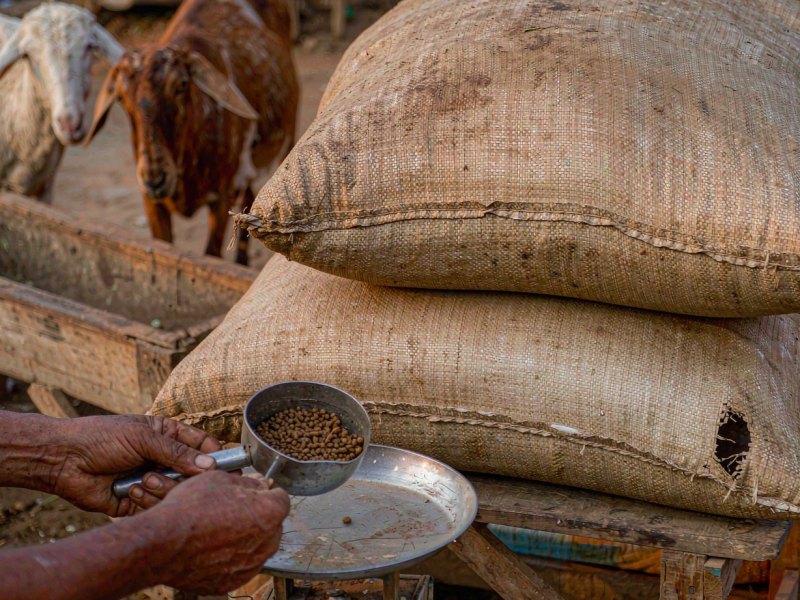
The National Sheep and Goat Development Association of Nigeria has asked the federal government to publish livestock feed prices nationally, together with stronger inspection of feed quality. Speaking to reporters in Abuja in late October, association president Abdullateef Ahmed said prices move too fast and too quietly for farmers to plan, and blamed weak regulation of producers.
The list of products the association wants tracked is the interesting part. Not only maize and other cereals, but soybeans, wheat offal, maize bran, rice bran, palm kernel cake, hay, silage, commercial sheep and goat concentrates and mineral supplements. In other words, the entire concentrate and premix layer of the market, which is exactly where a farmer's margin is decided and where he currently has the least price information.
Ahmed's argument is blunt. Cheap but unsafe feed can cost a farmer more than expensive, reliable feed. A bag that is short on protein, high in mycotoxins or missing its mineral premix shows up three months later as poor growth, empty ewes and dead lambs, and by then nobody can trace the cause back to the bag.
Two things follow for anyone buying or selling feed in the region. First, price transparency will favour suppliers who can document what is inside the bag. When a state publishes a price with the unit of measurement and the product quality attached, a bag without a specification becomes a bag without a price. Farms will start asking for the analysis sheet before they ask for the discount.
Second, mineral supplements and concentrates are now part of the policy conversation. For years the small ruminant sector in Nigeria was treated as a scavenging system that needed no purchased inputs. That assumption is being retired, and premix suppliers who already serve poultry and cattle have a reason to build sheep and goat formulations with a clear calcium to phosphorus ratio, zinc, selenium and copper levels that are safe for sheep, and a declared inclusion rate.
The association also asked for community-based feed banks, local fodder production and better storage. Those are practical proposals, but they only work if the feed that goes into the store is worth storing. A community bank filled with undated, unlabelled bags simply moves the risk from the market to the village.
This is also the honest answer to why livestock feed is so expensive in Nigeria. Part of the cost is the raw material, part is transport and diesel, and part is the absence of information, which lets weak products circulate at prices that look competitive and are not. Ahmed noted that when feed gets too expensive, farmers cut the quantity they offer, which reduces growth, delays reproduction and raises mortality among young animals.
That mechanism explains the empty market every festive season. The animals were not lost to disease, they were underfed six months earlier, and nobody connected the two events.
For feed buyers, the practical response is boring and effective. Ask for the batch date, the crude protein and lysine figures, the premix inclusion rate and a recent toxin test. Buy concentrates on a per-kilo-of-gain basis rather than per bag. Record the price with the date and the actual weight of the bag, because a 25 kg bag and a bag sold as 25 kg that weighs 22 kg are not the same purchase.
Jinmao Biotech produces ruminant and poultry premixes with batch documentation and specification sheets for each market we serve. Our technical team is on WhatsApp if you need help comparing two offers on paper before you compare them in the pen.