
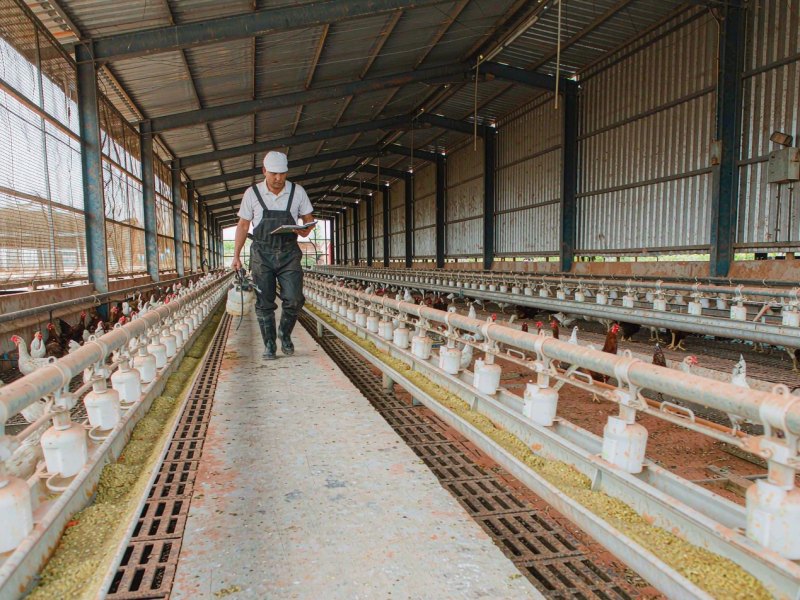
Nigeria's federal livestock ministry and FAO spent the second week of November training officials and industry stakeholders on a new avian influenza early-warning system. The message for commercial poultry farms is direct: the data you record now is what the forecast will be built from, and the weakest link in that chain is mortality reporting.
What was actually announced
At a four-day national workshop in Abuja that opened on 9 November 2026, the Chief Veterinary Officer of Nigeria, Dr Samuel Anzaku, presented the Avian Influenza Decision Support Tool, developed with FAO under the Animal Mobility Intelligence Framework known as ELEVATE, project TCP/NIR/4101. The tool combines animal movement data, community-based reporting, wild bird flyways, live bird market hotspots and risk scenarios to point at where an outbreak may appear next rather than where it has already been. Kano and Lagos were chosen as pilot states because of their exposure.
The figures given at the workshop explain the urgency. Nigeria recorded 1,096 outbreaks of highly pathogenic avian influenza between 2015 and 2023, with about 6.9 million birds exposed and more than 5.7 million culled. FAO's livestock team lead in Nigeria, Dr Otto Vianney, noted that with no avian influenza vaccination in use, biosecurity remains the only barrier, and that preventive measures should be in place roughly three months before cases are expected. FAO's Claudia Pittiglio added that genetic work points to several separate introductions of the H5N8 strain from wetlands shared by wild birds and domestic ducks.
Two days later, on 11 November, a joint team walked Wuse Market in Abuja with the ministry's Dr Mitchell Alao to see how birds arrive, how they are handled and how the site is cleaned. Gaps were identified. A market that receives birds from an infected area becomes a hotspot in its own right, and Abuja sits on the routes that connect the north to the south.
What a farm should do this month
Three months before an expected outbreak means now, not January. The practical list:
- One gate, one footbath, one pair of boots. No worker returning from a live bird market in the same clothes.
- All-in, all-out with a real empty period between batches, and no mixing of market birds with farm birds.
- Mortality written down daily, by house. Inconsistent mortality reporting is exactly the weakness the new tool cannot repair.
- Closed feed bins, no spilled grain under the silo, netting where wild birds gather. Feed on the ground is an invitation.
- Water lines cleaned on a schedule, because biofilm protects whatever passes through it.
- Birds kept unstressed. Heat, ammonia and overcrowding do not cause avian influenza, but they lower the threshold at which any infection spreads.
On the nutrition side the useful actions are modest and cheap. Keep a mycotoxin binder in the diet when grain quality is uncertain, hold vitamin and electrolyte support through hot spells, and do not stretch the ration with extra bran at the exact moment the birds need density. A flock that is already marginal has no reserve when a challenge arrives.
For feed buyers the same logic applies one step back. Sealed bags with a certificate of analysis, a supplier who can name the batch and the date, and a store that keeps feed off the floor and away from wild bird droppings are part of your biosecurity, not just your purchasing. If you want our premix specification sheet or a feeding plan for your next batch, message us on WhatsApp.