
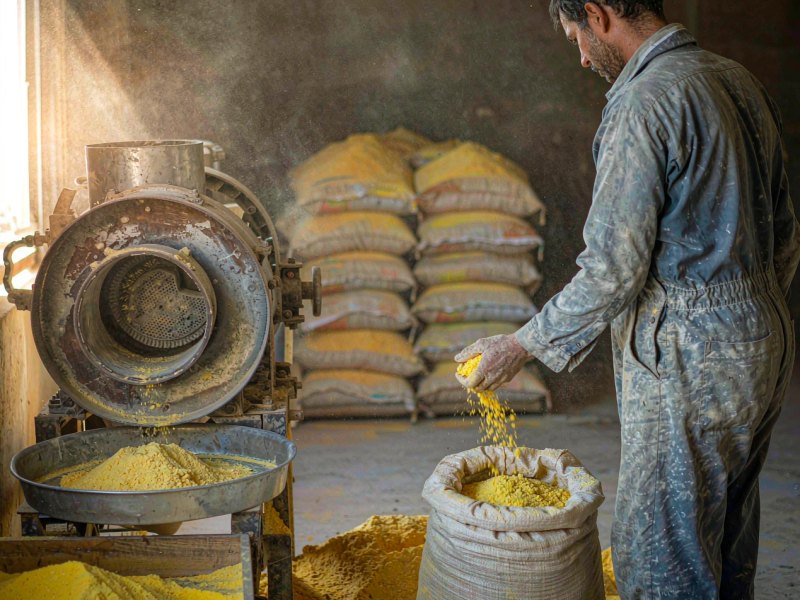
In most West African feed mills the argument is about the price of maize and the premix inclusion rate, while the hammer mill screen quietly decides how much of that feed the animal can actually use. Particle size is the cheapest lever in the plant: one screen change costs almost nothing and it moves feed intake, gizzard development, sorting and pellet quality at the same time.
What each class of stock actually needs
There is no single setting for the whole farm. Practical targets used by commercial mills:
- Broiler starter, 0 to 14 days: fine, about 0.7 to 0.9 mm, because the beak is small and the gut is short.
- Broiler grower and finisher: 0.9 to 1.2 mm, with a little whole grain if you can control it.
- Layer mash: 0.8 to 1.1 mm for the cereal fraction, but keep limestone coarse at 2 to 4 mm so it stays in the gizzard overnight.
- Piglets and weaners: 0.5 to 0.7 mm, grower and finisher 0.7 to 0.9 mm, and gestating sows deliberately coarser at 1.0 to 1.2 mm for stomach health.
- Cattle and sheep concentrate: 2 to 4 mm, never flour fine, because very fine meal ferments too fast in the rumen.
Why too fine costs you money
Over-ground meal behaves like dust. It bridges in bins, it cakes on the drinker line when birds flick it, and it leaves the feeder with every wing beat, which is 1 to 2 percent of the bag and more than the margin on most premix. Fine mash also passes the gizzard too quickly, and the gizzard is the organ that grinds and regulates flow. On dusty, uniform meal you see more sorting and wetter litter. In pigs, meal below 0.5 mm is linked with gastric ulcers, which is why sow diets are kept coarse.
Why coarse fails too
Go the other way and the birds eat the maize and leave the fines, which is where the premix, the amino acids and the minerals sit. Once particle sizes are spread wide, segregation in the bag and in the feeder is inevitable. A coarse, uneven grind also gives weak pellets, more fines at the cooler and more broken pellets at the farm.
Measure it with kitchen sieves
You do not need a laboratory. Take 200 g of meal, stack sieves of 2 mm, 1 mm and 0.5 mm over a bottom pan, shake for two minutes and weigh what stays on each level. For broiler mash, aim for most of the sample between 1 mm and 0.5 mm and under 20 percent in the pan. Repeat the test every time you change maize supplier, because hard flint maize and soft local maize do not grind the same way on the same screen.
Three mill settings that change the answer
Worn hammers and a cracked screen give a wide, uneven grind even when the screen size looks right. Damp maize above 14 percent moisture smears instead of shattering, so dry the grain first. And watch throughput: moving from a 3 mm to a 2 mm screen can cut output by a fifth and raise energy per tonne, so two passes, one coarse and one fine, are often cheaper than forcing a single pass.
One last habit that costs nothing: add the premix after grinding, never before, and never tip it into a batch that is still hot and venting steam. If you want a second opinion on the right screen for your ration, send us your sieve result and your species mix on WhatsApp and we will tell you what we would change.