On 26 March 2026, the International Finance Corporation announced a loan of about 20 million dollars to FERMAV Industries, a subsidiary of Guinea's SONOCO Group, to build the country's first vertically integrated poultry operation. The number sounds modest next to mining headlines, but for anyone selling feed, premix or feed ingredients in West Africa it is one of the clearest signals of the year: a new industrial customer is being built from zero in a market that today imports around 85 per cent of the chicken it eats. Producers and traders watching Guinea's first integrated poultry project should look closely at how it is financed and what it buys.
Why Guinea imports almost everything it eats
Guinea's poultry sector remains dominated by small traditional flocks. FAO figures show chicken meat imports rising 63 per cent in five years, from 49,735 tonnes in 2020 to 81,193 tonnes in 2024, an annual bill above 100 million dollars, while domestic production has stayed around 14,000 tonnes a year. The Ministry of Livestock estimates that local farms cover less than 5 per cent of national consumption. With demand growing about 10 per cent over the past five years, the government is preparing a 2026-2030 national poultry strategy built on seven pillars, including animal feed development and biosecurity, and has set a target of raising domestic production to 30 per cent of demand by the end of 2026.
What is actually being built
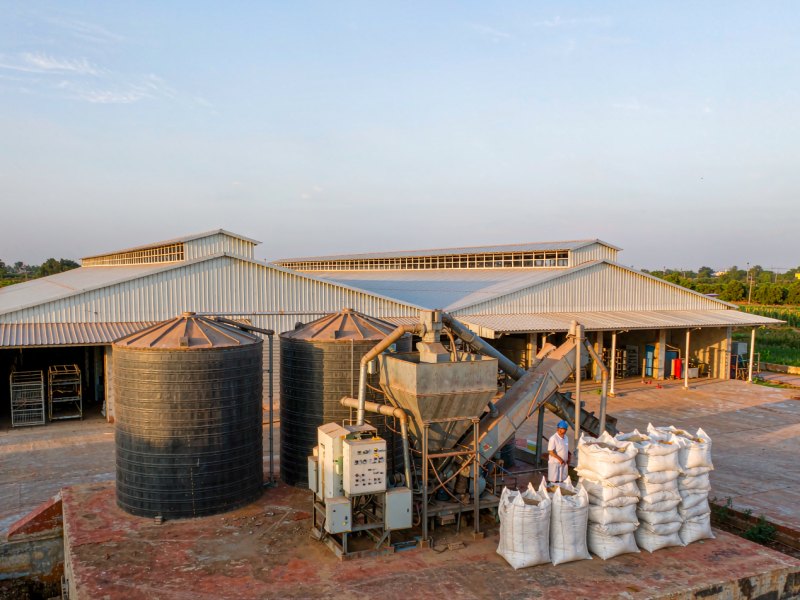
The project covers the whole chain. A breeding centre and a hatchery are going up at Daboyah near Kindia, a slaughterhouse at Massayah, and a dedicated feed mill at Sanoyah, with construction already advanced and operations expected to ramp up from March 2027. IFC's board approved its eight-year senior loan in March 2026, part of a 49-million-dollar investment programme. The target is roughly 15 million broilers a year, with about 400 direct jobs and nearly 3,500 indirect ones in farming, processing, logistics and distribution. SONOCO is not a newcomer: the group, founded in 1992 and best known for its flour mills, has been an IFC client since 2019.
What it means for feed suppliers
The detail that matters most to our industry is that feed mill. A mill sized for 15 million broilers a year needs a steady flow of maize, soybean meal and wheat bran, and it needs premixes, enzymes, amino acids and toxin binders to keep quality consistent. Feed represents 60 to 70 per cent of the cost of producing chicken meat, so whoever supplies that mill at the right quality and price will have a customer for years. The same logic repeats across the region: Senegal, Cote d'Ivoire and Ghana are all pushing import substitution in poultry, and every one of those plans starts with feed. Vertical integration is not only a big-company story, it is the main new channel through which feed demand appears in West Africa.
For Jinmao Biotech, working with integrated projects and independent mills across West Africa, the lesson is simple. Growth is arriving in places where the supply of technical feed products is thinnest. If you are building or expanding a feed mill in Guinea or neighbouring markets, send us a message on WhatsApp to discuss premix and additive supply matched to your raw materials.