
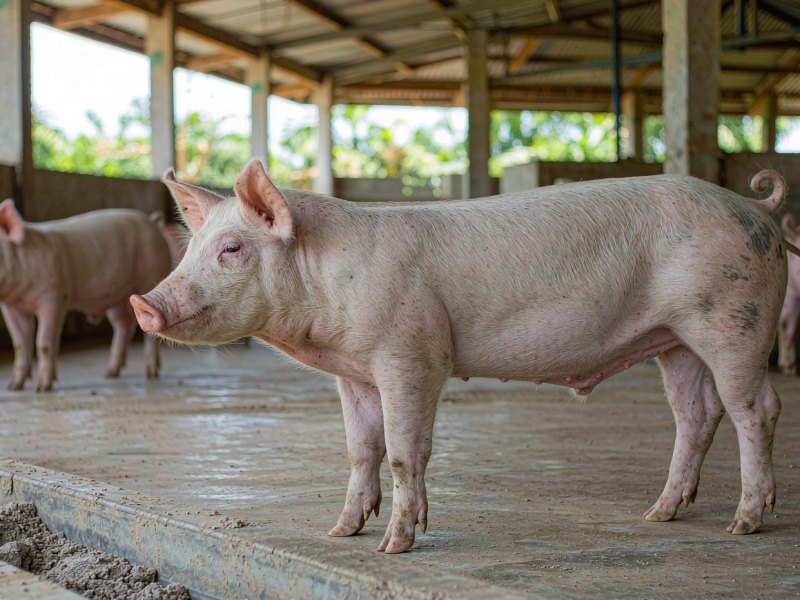
A gilt that has not shown a heat by eight months is usually not a genetic problem. In most West African pig units the cause sits in the feed bucket and in the pen next to it. The female was reared like a finisher pig, reached 110 kg at five months, and now carries so much backfat that her cycles are weak and silent. Or she was kept on kitchen waste and bran, is thin at 90 kg, and has never had the energy to start at all.
The target is easy to state. A gilt should be served for the first time at 230 to 240 days of age, at 130 to 145 kg live weight, with 16 to 18 mm of backfat at the P2 point. Rate of gain matters as much as the final weight. Gilts pushed above 800 g per day from 60 kg tend to lay down fat and show short, quiet heats. Gilts held under 500 g per day arrive at the weight late, and every extra week before first service is feed spent with no piglet to show for it.
From about 100 days of age a gilt needs a developer diet, not a grower diet and not sow feed. Expect roughly 14 per cent crude protein, 0.70 per cent total lysine, 0.85 per cent calcium and 0.40 per cent available phosphorus, with a full trace mineral and vitamin package. Zinc, selenium, vitamin E and iodine are cheap inside a premix and expensive to leave out, because they drive hoof soundness, teat development and the first ovulation.
Feed allowance should follow the body, not the calendar. Feed ad libitum to about 100 kg, then step down to 2.2 to 2.5 kg per day of the developer diet so that daily gain settles at 600 to 700 g. Weigh a sample of ten gilts every month and adjust the scoop, not the whole bag. A farm without a scale cannot manage gilt development, because the whole programme depends on weight and age read together.
Boar contact is the step most farms skip, and it is the cheapest. From 160 days of age, move gilts into a pen where they can see, smell and touch a mature boar for 15 to 20 minutes a day. Rotate the boars, because gilts quickly become accustomed to one animal and stop responding. Full physical contact works far better than a fence line alone. Never mate at the pubertal heat. The second or third heat gives a heavier litter and far fewer gilts that fail to hold.
Light and heat matter as well. Gilts need 14 to 16 hours of light a day and a house that stays below 28 degrees in the afternoon. A dark, hot pen can delay puberty by three or four weeks without any other fault on the farm.
Keep one card per gilt with date of birth, weight at 100 days, date of first heat and date served. In three months those cards will tell you more about your breeding herd than any laboratory report, and they cost nothing.
A developer premix built to this specification is one of the cheapest interventions on a pig farm, because it decides how many piglets each sow will give you across four parities. If you want the inclusion rates and the vitamin and trace mineral levels we use for gilt developers, our technical team can send the specification over WhatsApp.