
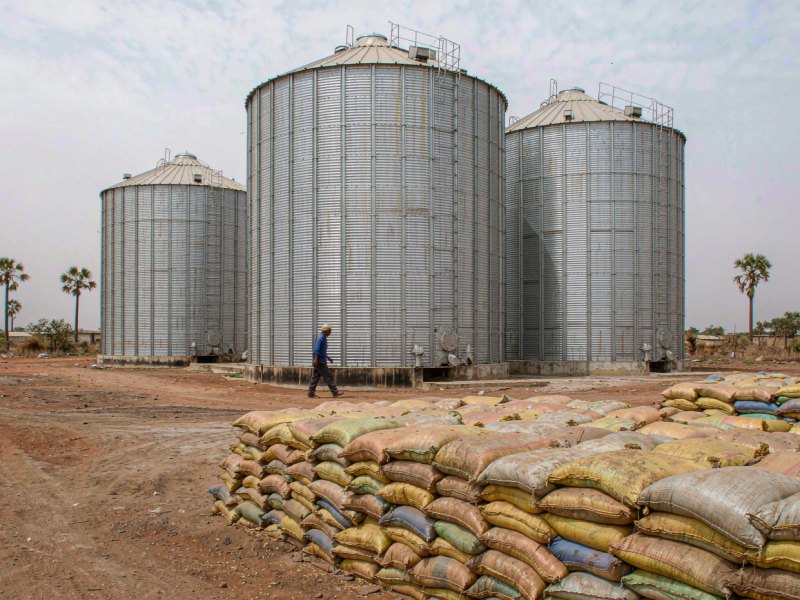
Ghana's Ministry of Food and Agriculture signed an agreement with DMT Collateral Management on 3 November for a 21,000 tonne grain storage facility in Wa, in the Upper West Region. The project is valued at about 10.9 million dollars, financed partly by an export credit of roughly 4.8 million euros arranged through the Danish Embassy plus about 5 million dollars of additional investment. Completion is scheduled for August 2027.
Read on its own, a silo in the north-west looks like a food security story rather than a feed story. It is both. Ghana produced about 6.4 million tonnes of cereals in 2025, 12.3 per cent above the five year average, according to the FAO. The agriculture minister, Eric Opoku, put 2025 maize output at 4.6 million tonnes against domestic demand of about 3.6 million. A theoretical surplus of one million tonnes is only worth something if it can be dried, held and moved. Without storage it becomes a price collapse at harvest and a price spike six months later.
That pattern is familiar to anyone buying maize in West Africa. Prices are lowest in the six weeks after harvest, when everyone sells at once, and highest in the lean season, when mills bid against each other for the last bags in the market. A working silo network flattens part of that curve. It also changes what a mill is able to buy. Grain dried to 13 per cent moisture and held under controlled conditions keeps its feed value, while grain bagged in a humid store loses energy, grows mould and accumulates aflatoxin.
For anyone mixing feed, the quality point matters more than the price point. Aflatoxin does not disappear when maize is ground. It damages the liver, depresses growth, cuts egg production and weakens the response to vaccination. A toxin binder or a well built premix can reduce the damage, but neither can rescue grain that was already spoiled. Better storage at origin is the cheapest mycotoxin control available to the region.
The Wa facility is presented as the first of a national programme, with 15 to 20 similar sites under consideration. The Feed Ghana Programme, launched in April 2025 and running to 2028, also targets rice silo capacity of 200,000 tonnes by 2028, ten warehouses of 1,000 tonnes each in sorghum areas, an extra 125,000 tonnes of soybean warehousing and rehabilitation of maize stores.
A second thread is running alongside. Ahead of the 2027 budget reading on 12 November, the Peasant Farmers Association of Ghana and the Greater Accra Poultry Farmers Association asked for at least 10 per cent of the budget to go to agriculture. The poultry group's chief executive, Mohammed Ali, asked specifically for maize and soybean storage and for guaranteed off-take contracts linking crop farmers to feed millers. That is the same request seen from the other side of the trade.
So what should a feed buyer or a livestock farm do with this news? Three things. Buy and store at harvest rather than in the lean season, if working capital allows it. Test moisture and aflatoxin on every incoming load, not once a year. And treat bagged grain in a humid store as a six week product rather than a six month one, because that is what it is.
Storage capacity in the region is improving, but slowly. Until it improves faster, the farm that controls its own grain quality controls its own feed cost. If you are setting up a grain store or a mixing line, our team can share a simple intake and moisture checklist over WhatsApp.