
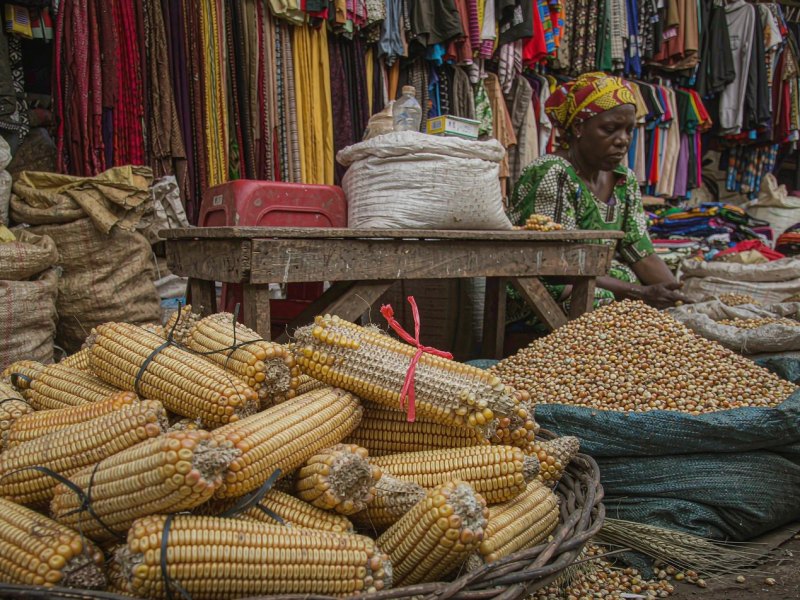
Ghana's September inflation figures, released by the Ghana Statistical Service on 7 October, contain news that matters more to feed buyers than the headline rate. Consumer inflation edged up to 5.2 per cent from 5.0 in August, still far below the 9.4 per cent of September 2025. Inside the food basket, however, the movements were striking. Maize, the backbone of poultry and livestock rations, cost 26.4 per cent less than a year earlier, and local rice and beans also fell sharply. Fresh tomatoes, by contrast, rose 153.4 per cent, and ginger more than doubled.
A rare price window
The domestic slide stands out because world markets are moving the other way. The World Bank Pink Sheet put maize at 239.60 dollars a tonne in September, up 21.4 per cent year on year, and soybean meal at 447 dollars a tonne, up 24.9 per cent. A steadier cedi has kept imported inflation at just 2.4 per cent, which cushions the cost of imported goods. The result is an unusual window in which Ghanaian energy ingredients are cheap while global feed benchmarks keep climbing.
Why Ghana's feed imports are rising despite cheaper maize
The question many buyers ask is why Ghana's feed imports are rising despite cheaper maize. Despite the local grain glut, the country keeps importing more feed, not less. According to IndexBox trade data updated on 19 October, Ghana imported 57.1 million dollars of animal and pet feed in the twelve months to March 2026, 34.7 per cent more than a year earlier, at an average import price of about 705 dollars per tonne. Much of that flow sits in the processed feed basket, premixes, concentrates, supplements and complete rations, rather than raw maize. Raw energy is available at home, while the vitamins, trace minerals and specialty additives that balance a diet are still bought abroad.
What the arithmetic favours
For a feed miller or a large farm, the numbers of the moment favour mixing locally. A tonne of local maize combined with an imported premix or concentrate usually beats the landed cost of a complete imported ration, and it keeps spending in the local grain market. With maize 26 per cent cheaper than last year, margins on home-mixed feed have widened even as world prices rise. That gap is exactly where a well-run mill finds its profit.
Three actions from the data
First, secure maize while it is cheap, because a good harvest will not hold prices down through the lean season, and careful drying and storage protect both price and quality. Second, control mycotoxins, since humid stores are precisely where aflatoxin develops in maize, so test lots before mixing rather than after a performance problem appears. Third, import the small things, not the heavy ones. A bag of premix carries the vitamins, minerals and enzymes that decide performance, while the bulky maize comes from down the road.
Jinmao Biotech manufactures vitamin and mineral premixes and feed additives for the West African market. For advice on balancing local maize with a premix, or for a quote, contact our team on WhatsApp.