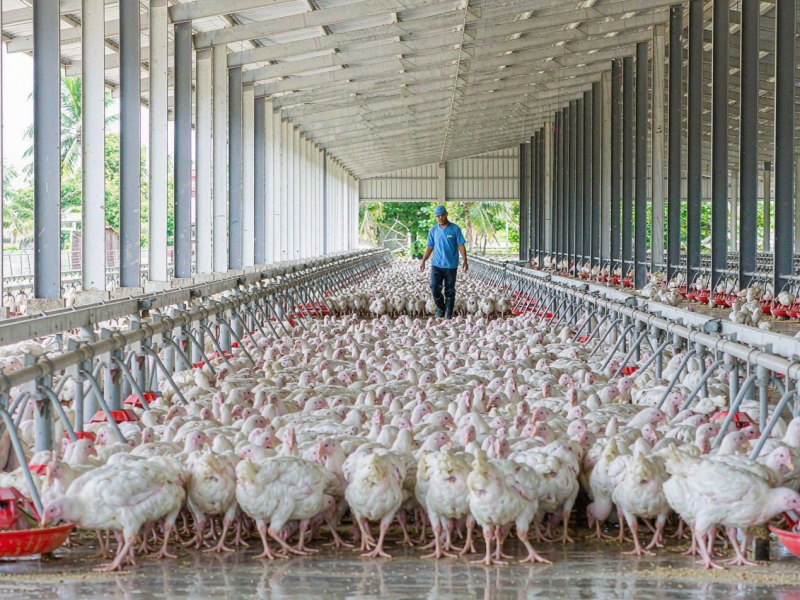
On 22 October in London, Ghana's 24-Hour Economy and Accelerated Export Development Programme, known as 24H+, signed a 270 million dollar agreement with UK-based Agrium Capital, a subsidiary of Asset Green Ltd, to build an integrated poultry industry. The signing follows heads of terms agreed in Accra on 22 August. Ghana spends about 400 million dollars a year importing chicken and poultry products, and this deal is aimed squarely at that bill.
The headline numbers are 12,000 direct jobs and 20,000 tonnes of dressed and processed broiler products a year in the first phase, with room to reach 50,000 tonnes. The scope is deliberately end to end, covering feed production, breeding, hatcheries, broiler farming, processing, cold chain, logistics and market access. Petra Trust, Axis Pension Trust and Ghana EXIM Bank are partners, and the Tony Blair Institute for Global Change, which hosted the August signing, has acted as a catalytic partner.
What matters for anyone selling into the feed chain is the volume behind those tonnage figures. At a dressing yield of about 72 per cent, 20,000 tonnes of dressed product implies roughly 27,800 tonnes of live bird. At a feed conversion ratio near 1.65, that is in the order of 45,000 tonnes of compound feed a year. At 50,000 tonnes of output, feed requirement would pass 110,000 tonnes. These are our own arithmetic estimates, not figures released by the parties.
Translate that into premix and the commercial signal is clear. At a typical inclusion of 0.25 to 0.5 per cent, 45,000 tonnes of feed absorbs roughly 115 to 230 tonnes of vitamin and mineral premix a year. That is a meaningful, repeatable volume for a regional supplier, and it is the kind of volume won before the first bird is placed, on specification and documentation rather than on price alone.
Three things follow for local feed producers and additive suppliers. First, get documentation ready now. An investor-backed operation will ask for certificates, batch analysis, heavy metal and mycotoxin results and a stable specification sheet, and will audit before approving a supplier. Second, expect a specification that is written down and tested, not negotiated per delivery. Third, prepare technical support in French and English, because staff running such a project are often recruited regionally.
A note of caution is warranted. The October instrument is described as an addendum to the August heads of terms, funding further technical and investment work. No construction date, site or first-output date has been published. This is a project moving from framework to preparation, not a finished plant. Feed demand will arrive in stages, and suppliers who plan capacity on the full 50,000 tonnes will wait longer than they expect.
The wider point is that Ghana is no longer only talking about import substitution. Successive announcements, from the national poultry programme to this private capital deal, point the same way. For feed mills in Ghana, Nigeria, Togo and Côte d'Ivoire, the opportunity is not simply more tonnage. It is being the supplier whose premix, enzymes and toxin binders are already approved when the first feed plant starts commissioning.
Jinmao Biotech supplies vitamin and mineral premixes, enzymes and toxin binders to feed producers across West Africa, with batch documentation available for supplier qualification. If you are preparing for a tender or an audit, contact our technical team on WhatsApp.