
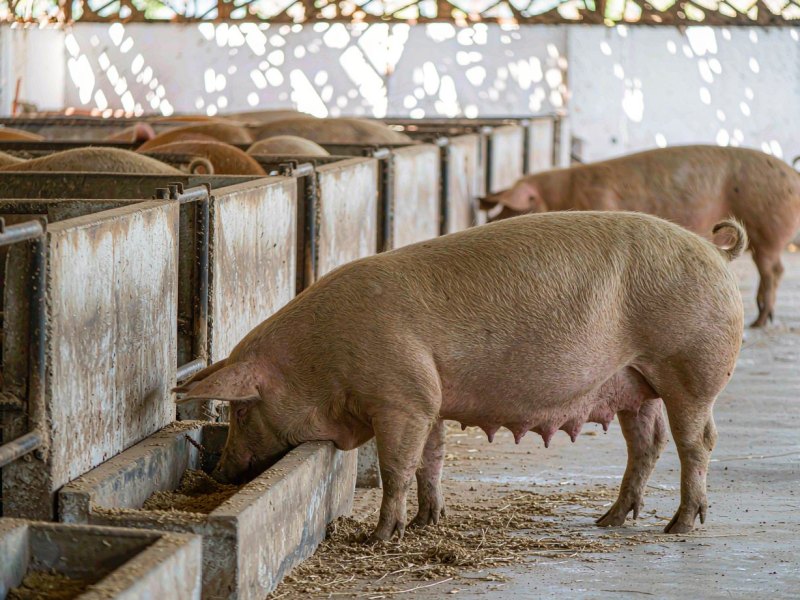
A sow that is overfed in gestation costs you twice, first on the feed bill and again at farrowing. The question we hear most often from pig farmers here is simple. How much feed should a pregnant sow get per day? The honest answer is that it depends on her body condition, her parity and how far she is into the 114-day pregnancy. A flat 3 kg per day for every sow is not a feeding programme, it is a guess.
Score her at mating and again around day 30. Use a five-point scale and your hands rather than your eyes. A sow in the right condition sits at 3 out of 5. The hip bones can be felt but not seen, the spine is covered, and the ribs are not visible. In backfat terms, 16 to 19 mm at the P2 point is the target for a mature sow. Anything above 20 mm is fat you will pay for twice, because fat sows eat less in lactation and crush more piglets.
For a mature sow weighing 180 to 220 kg, 2.0 to 2.2 kg per day of a gestation diet is enough for the first 80 days. That diet should carry 13 to 14 per cent crude protein, 0.55 per cent lysine, 0.85 per cent calcium and 0.35 per cent available phosphorus. Feed thin sows and sows raising a heavy litter for the first time closer to 2.5 kg. Hold fat sows at 1.8 kg and correct the error across two pregnancies, not one week.
First-litter gilts are still growing and need more than mature sows, around 2.5 to 2.8 kg per day. A gilt that gains 25 to 30 kg across her first pregnancy will farrow a heavier litter and will still be productive at parity five. Starve her to keep her small and you will cull her early, the most expensive outcome available.
About 45 per cent of total piglet birth weight is laid down in the final three weeks. From day 85 onwards, step the allowance up to 2.8 or 3.0 kg. This is the cheapest intervention in the whole cycle for birth weight and survival, costing roughly one extra bag per sow.
Constipation is common in crated sows and is almost always a fibre and water problem, not a disease. Include 8 to 12 per cent wheat bran, rice bran or another palatable fibre source, and check that every sow can reach clean water at any hour. A gestating sow drinks 10 to 20 litres a day in this climate. Restricted water also raises the risk of urinary infection, a quiet reason sows return to service.
In the hot season, feed between 06:00 and 08:00 and again after 17:00. Above 28 degrees Celsius in the shed, sows eat less and digest less efficiently. Wet the floor and the sow's neck at midday if labour allows, and handle animals only in the cool hours.
Store maize properly. Zearalenone and deoxynivalenol are reproductive risks, not just growth risks. They cause swollen vulvas, irregular returns to service and small litters, with no other visible sign. Buy maize at 13 per cent moisture or below and use a toxin binder in the gestation diet.
Finally, calibrate your scoop monthly against a kitchen scale. Many farms that believe they feed 2.2 kg are feeding 2.8 kg, and that error alone is worth several bags per sow per year.
Our sow premix carries the vitamin and trace mineral package a gestation diet needs, including biotin for hoof strength and organic selenium. For a second opinion on your ration, send your sow weights and current formula on WhatsApp and we will check the numbers.