
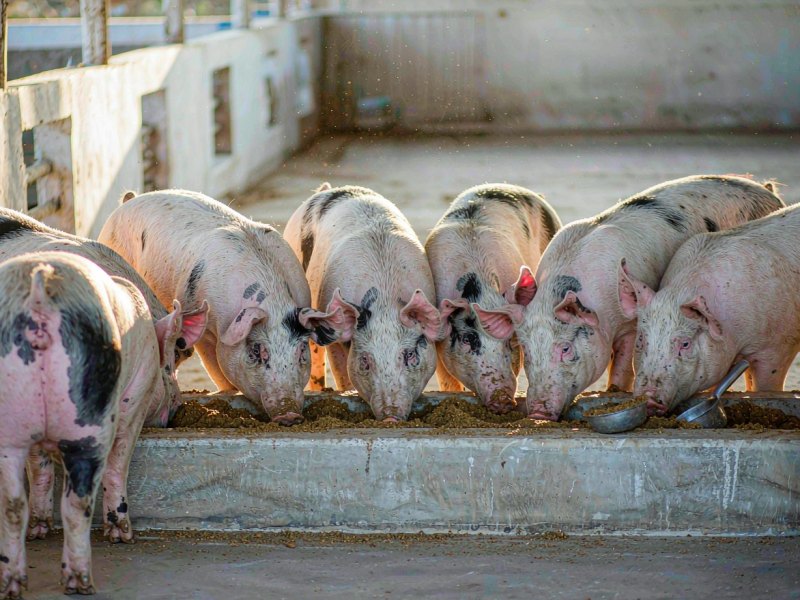
Most pig farmers in West Africa know that feed takes 65 to 75 percent of production cost, yet many of them run the whole finishing stage on one bag of feed from 60 kg to slaughter. That habit costs more than any ingredient price. Finishing pigs are the cheapest animals on the farm to feed well and the most expensive to feed badly, because every day a pig stays in the pen after it has stopped converting feed into lean meat is a day of pure loss.
Start with the target. A local pig should reach 90 to 110 kg live weight in roughly 150 to 170 days. In the finishing phase, from 60 kg to slaughter, expect daily gain of 700 to 900 g and a feed conversion ratio of 2.8 to 3.2 kg of feed per kg of gain. If your pen is running at 3.8 or 4.0, the problem is usually diet form, feed wastage or water, not the genetics of the pig.
Split the finish into two diets instead of one. From 60 to 85 kg, feed a finisher with 15 to 16 percent crude protein and 0.80 to 0.90 percent total lysine, at about 3.2 to 3.3 Mcal digestible energy per kg. From 85 kg to slaughter, drop to 13 to 14 percent crude protein and 0.65 to 0.75 percent lysine. This second step is where the money is made, because at that weight the pig is depositing fat rather than lean, and surplus protein is simply excreted as expensive nitrogen.
Do not simply remove soybean meal to save money. Replace part of it with synthetic lysine, methionine and threonine, plus a mineral and vitamin premix at 0.2 to 0.3 percent of the diet. Pigs on cereal and by-product based diets in this region are usually short of lysine first, then methionine and threonine. A bag that looks cheaper per kilo but loses 100 g of daily gain is the most expensive bag in the store.
Feed to appetite, but weigh the feed. So how much feed does a pig need to reach market weight? In the finishing phase it eats 2.0 to 2.5 kg per day, more in cool weather and noticeably less under heat stress. Weigh what you put in the trough for one week and compare it with what the pen actually gains. Most farms overfeed the last two weeks and underfeed the middle, and both mistakes show up on the carcass.
Water decides intake. A finishing pig needs 2.5 to 3 litres of water for every kilo of feed. Check nipple flow rate, clean the line, and make sure the drinker height suits a 100 kg animal and not a 30 kg weaner. A pen that drinks slowly will eat slowly, and no formulation can compensate for that.
Heat is the hidden cost. Above 28 to 30 degrees Celsius, pigs cut intake by 15 to 30 percent. Feed early morning and late evening, keep the floor cool and wet, increase ventilation, and raise nutrient density slightly rather than forcing the animal to eat more than it wants.
Weigh a sample of ten pigs every two weeks. When average weight is within 5 kg of your market target, sell. Keeping a pen an extra ten days to add 8 kg usually costs more feed than the extra kilos are worth, and buyers discount over-fat carcasses anyway.
Finally, stop feed 8 to 12 hours before slaughter but never stop water. A full gut costs you weight at the scale and creates dirty carcasses that traders remember at the next purchase.
Jinmao Biotech supplies pig premixes and feed additives formulated for the cereal and by-product based diets common in West Africa. Send your current ration to our technical team on WhatsApp for a second opinion.