
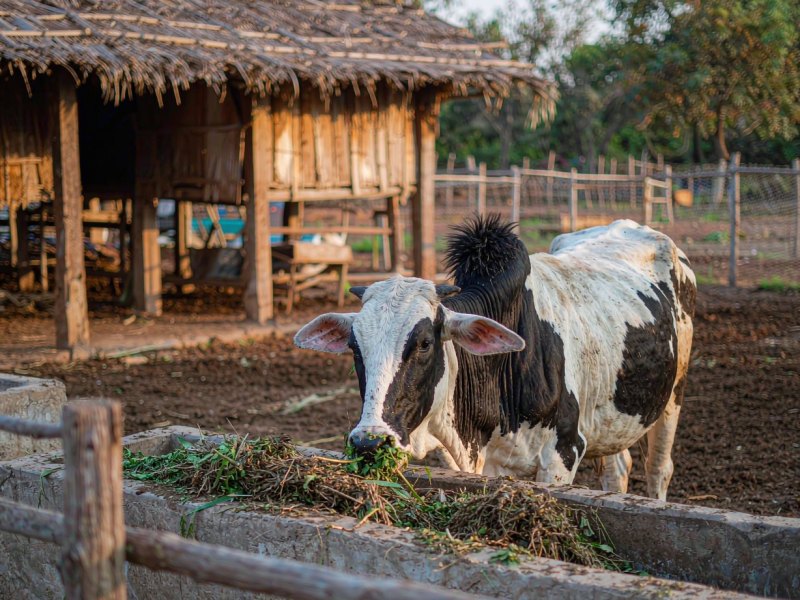
On many West African dairy farms, the milking cows get the best feed and all the attention, while the young heifers eat whatever is left. It is an expensive habit. Every extra month a heifer stays open is a month of feed with no milk in return, and a heifer that calves late and light gives a shorter, weaker first lactation. The target is simple. First calving at 22 to 24 months, weighing close to 85 percent of mature body weight.
Growth should never be guesswork. Weigh a sample of heifers every month, on the same day and before morning feeding, and write the numbers down. Crossbred heifers, for example Holstein or Jersey crossed with local Zebu, should gain roughly 0.5 to 0.7 kg per day from weaning to breeding. If weights stall for two months, something is wrong. Check worms and ticks first, then the forage and the concentrate.
From three to six months, just after weaning, the rumen is still developing and the calf cannot live on rough grass alone. Offer the best forage available with 1 to 2 kg of a quality grower concentrate supplying 16 to 18 percent crude protein. Aim for steady frame growth rather than fat, because a young heifer pushed too hard on energy lays down fat inside the udder and milks less for it later.
From seven to fifteen months, good leafy forage can carry most of the growth, but old yellow grazing is mostly fibre and heifers on it fall behind. Adjust concentrate between 1 and 1.5 kg per day according to forage quality, and keep a mineral premix with calcium, phosphorus, salt and trace minerals such as zinc, selenium and iodine in the ration. Breed at about 60 percent of mature weight, usually around 15 to 16 months for crossbreds, on weight and not on age alone.
The last eight weeks before calving deserve special care. Move the heifer to the calving area, keep body condition around 3 to 3.5 on a five-point scale, and introduce gradually the ration she will receive after calving so the rumen adapts. An overfat heifer faces more calving difficulty, and a thin heifer milks poorly for months.
Nutrition only pays when health problems are under control. Deworm heifers on a regular programme and keep tick control going, because parasites steal the very feed you paid for. Clean water is part of the ration too. A growing heifer drinks 20 to 30 litres a day, and a heifer that drinks little eats little.
The most common mistake in the region is running heifers on crop residues alone. Maize stover and rice straw keep a heifer alive but not growing. If residues are your base forage, add a legume such as mucuna or leucaena, raise the concentrate, and never skip the mineral premix.
A balanced heifer grower ration is one of the cheapest investments on a dairy farm, because it decides when the next cow starts milking. Jinmao Biotech supplies vitamin and mineral premixes for dairy and heifer grower feeds, formulated to work with tropical forages. Contact our team on WhatsApp for a specification and a quote adapted to your farm.