
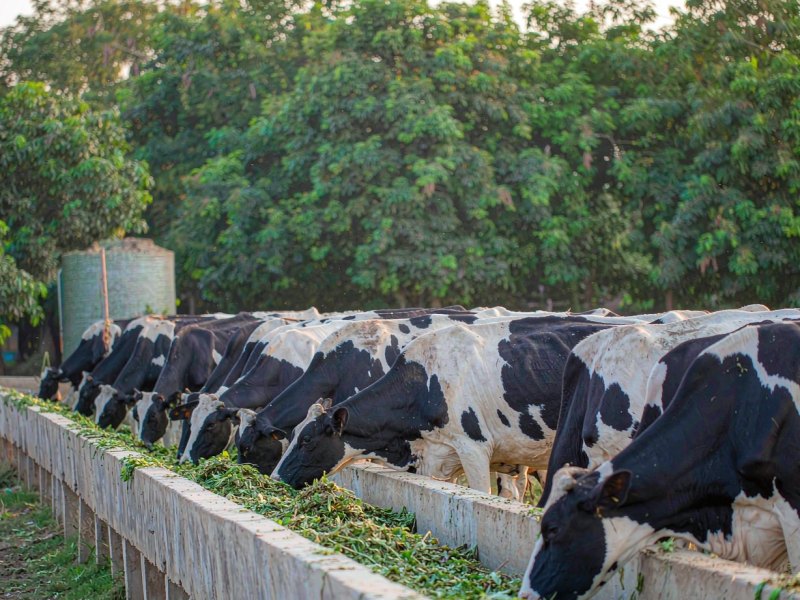
Ask a dairy farmer in Oyo, Kaduna or the highlands of Bamenda what limits milk yield and the answer will usually be feed quantity, breed or water. Rarely does anyone name trace minerals, yet the answer to the question of what trace minerals do dairy cows need explains many problems farmers blame on genetics. Cows that will not conceive, hooves that crack during the rains and udders that keep picking up infections often start with nutrients needed in grams or milligrams per day.
Zinc is the workhorse for hard tissues. It builds keratin in the hoof wall and in the skin around the teat end, and it powers the first line of immune defense. Cows short of zinc carry rough coats, heal slowly after routine handling and show more white-line cracks and foot lesions in muddy paddocks. In complete mineral premixes for lactating cows, practical inclusion works out at roughly 40 to 60 mg of zinc per kilogram of concentrate under tropical conditions.
Copper drives the enzymes behind fertility, coat colour and oxygen transport, but in many West African soils the first problem is not a lack of copper in the diet, it is copper being locked away. Molybdenum in certain valleys, iron in borehole water and sulphur in some agro-industrial byproducts all bind copper in the rumen before the cow can absorb it. Faded, rusty-looking coats and delayed or silent heats are the classic signs. Where antagonists are high, part of the copper should come in protected forms such as chelates or hydroxy sources instead of plain sulphate.
Selenium works together with vitamin E around calving. Deficient herds suffer more retained placenta, more metritis, more early-lactation mastitis and calves born weak with stiff legs, the condition known as white muscle disease. Selenium is genuinely low in many tropical forage areas, so a premix delivering about 0.3 mg per kilogram of total ration plus 100 to 200 IU of vitamin E is cheap insurance for the transition period.
Manganese, cobalt and iodine complete the picture. Manganese supports conception and bone formation in unborn calves. Cobalt feeds the rumen microbes that build vitamin B12, and a short supply shows up first as poor appetite in young stock. Iodine keeps the thyroid working, and an enlarged thyroid in a newborn calf is the classic field sign that the dry cow programme was short.
Source and form decide whether any of this reaches the cow. A rough salt lick supplies sodium but almost no controlled trace minerals. A properly formulated dairy premix included at 0.2 to 0.3 percent of the concentrate delivers the same small doses every single day, and protected organic forms of zinc, copper and manganese earn their premium in high-yielding cows under heat stress.
Three dosing rules keep the programme safe. First, never stack products, because two mineral feeds plus a free-choice lick can push copper past the toxicity line. Second, adjust for antagonists, shifting to protected sources where water is iron-rich or the ration carries a lot of wet brewers grains. Third, remember that the minerals protecting the next lactation are fed during the dry period, not after calving.
If cows keep repeating breeding, if hoof walls crumble every rainy season or if milk culture results keep coming back high, review the mineral side of the ration before blaming the bull or the herdsman. Jinmao supplies ruminant premixes balanced for tropical forage-based rations, including protected trace minerals. Send us a message on WhatsApp with your forage and water situation and we will help you size the inclusion rate.