
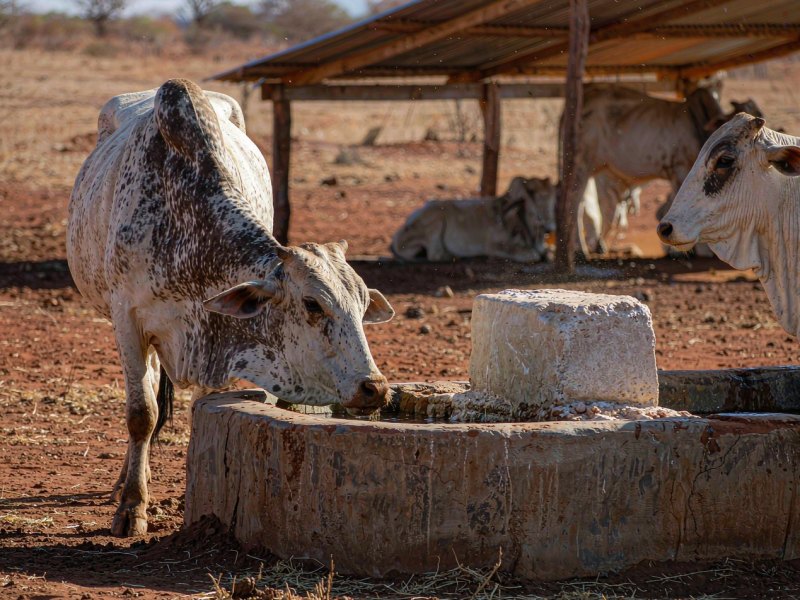
Every year between December and March, the heat across the Sahel and coastal West Africa climbs and dairy cows pay for it in lost minerals. A cow that is panting and sweating loses potassium through the skin, loses sodium and bicarbonate through saliva, and exports potassium in every litre of milk. On top of that, feed intake drops 10 to 25 percent on the hottest days, so the cow eats less of everything, including the minerals she needs most. Getting the electrolyte balance right costs very little and protects milk yield exactly when processors pay best.
Why heat drains potassium and sodium
Potassium is the main electrolyte in cattle sweat, and a cow that breathes fast spends saliva rich in sodium bicarbonate on panting instead of buffering the rumen. Milk carries about 1.3 to 1.5 grams of potassium per litre, so a 20 litre cow exports roughly 30 grams of potassium through the tank every day. When heat cuts feed intake, the cow cannot replace these losses from the ration, and the first sign is a quiet drop in milk yield and rumination minutes, not a clinical crisis. By the time a cow stops eating properly, you have already lost two weeks of milk.
The numbers that work in hot weather
- Potassium should rise from the usual 1.0 percent of dry matter to 1.3 to 1.5 percent during the hot season.
- Sodium should sit at 0.20 to 0.25 percent of dry matter, which means salt at 0.5 to 0.7 percent of the ration, and loose salt works faster than lick blocks in real heat.
- Magnesium at 0.25 to 0.30 percent, because high potassium forages block magnesium absorption and lush young grass after the first rains triggers grass tetany.
- Chloride at 0.25 to 0.30 percent and sulphur below 0.20 percent, so the dietary cation anion difference, calculated as sodium plus potassium minus chloride minus sulphur, lands around 250 to 350 milliequivalents per kilogram of dry matter.
What tropical forages hide
Most West African dairy rations are built on napier grass, brachiaria or crop residues, and young tropical grasses are extremely high in potassium, often 2.5 to 3 percent of dry matter, while sodium can sit below 0.1 percent. A cow grazing these forages with nothing but an occasional lick block runs short of sodium every single day. The same forages push the cation anion balance far above target, which is another reason to analyse the forage instead of guessing, and to supply magnesium oxide at 30 to 50 grams per cow per day when the grass is young and fast growing.
A practical hot season routine
Switch to a heat season mineral and premix program eight to ten weeks before your hottest months, because cows need time to build up body reserves before the stress arrives. Offer sodium bicarbonate at 150 to 200 grams per cow daily whenever concentrate levels are high, to restore the rumen buffering lost to panting. Protect water above all, because a milking cow in the heat needs 80 to 120 litres a day and will drink more if the trough is shaded, clean and refilled with cool water. Never borrow a poultry premix to stretch the dairy supply, since the copper and trace mineral levels are wrong for cattle and dangerous for sheep that share the pen. Watch milk fat and rumination minutes as your early dashboard, because both move before milk volume does.
Electrolytes are the cheapest kilograms of milk you will ever buy. Jinmao Biotech produces dairy premixes balanced for tropical forages and hot season feeding, and our team can review your ration free of charge. Contact us on WhatsApp for formulations and dosing support.