
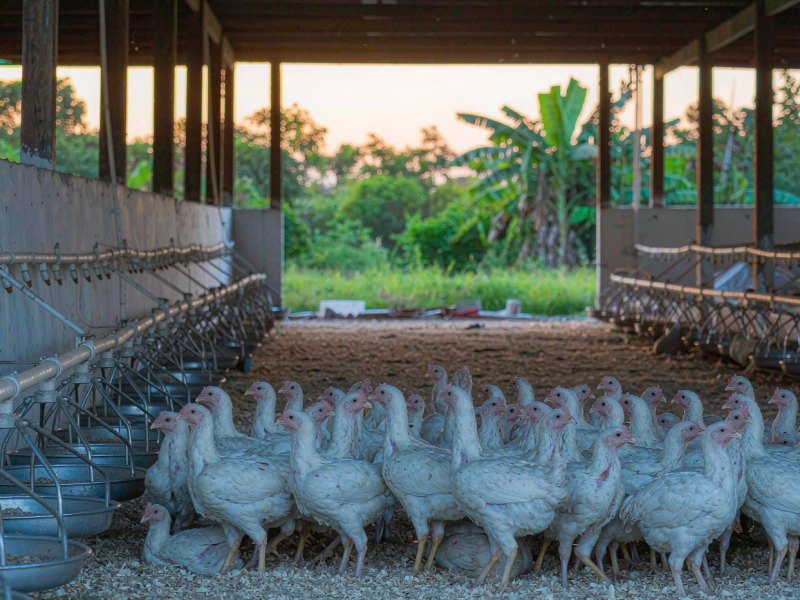
Lameness is one of the quietest losses on a broiler farm. A bird that sits down at day 25 is not eating, not competing at the feeder and not gaining weight, and by day 35 it is either culled or condemned at the processing line. Most farmers blame disease first. In practice, on the farms we visit across Nigeria, Ghana and Côte d'Ivoire, the dominant cause is a ration that does not match the growth rate the bird is actually achieving.
Leg strength is built in the first three weeks. The skeleton of a modern broiler reaches roughly 90 per cent of its mature size before the bird reaches 40 per cent of its final body weight, so any mineral deficit in the starter feed is paid for later, when the bird is heavy and the growth plate is already closing. Check calcium and available phosphorus first: 0.90 to 1.00 per cent calcium and 0.45 per cent available phosphorus in the starter, easing to about 0.85 and 0.40 in the grower, then 0.75 and 0.35 in the finisher. Keep the calcium to available phosphorus ratio close to 2 to 1.
Two mistakes cause most of the damage. The first is cheap filler. Limestone is the least expensive ingredient in the bag, so when a mill cuts cost it tends to add limestone, and a starter at 1.4 per cent calcium blocks zinc and manganese absorption and produces rickets instead of stronger bones. The second is trusting total phosphorus on the label. Maize and soybean meal hold much of their phosphorus as phytate, which the bird cannot use. Add a phytase at 500 to 1,000 FTU per kilogram and formulate on available phosphorus rather than on the total figure. Where bone meal is used, confirm that it has been sterilised, because raw bone meal brings both uneven mineral content and a bacterial risk.
Vitamin D3 is the second lever. Birds kept indoors on deep litter in humid conditions receive almost no ultraviolet light, so the practical requirement is 3,000 to 3,500 IU per kilogram of feed, and more in flocks with a history of leg weakness. A 25-hydroxy D3 source costs more but absorbs more reliably. Trace minerals come next: manganese at 100 to 120 ppm, zinc at 80 to 100 ppm, copper at 8 to 10 ppm, biotin at 0.15 to 0.20 ppm and choline at 1,300 to 1,500 ppm. A shortage of manganese, choline or biotin shows up as slipped tendon and crooked toes rather than soft bones, and it is almost always a premix or mixing fault rather than an ingredient fault.
Electrolyte balance is the part farmers rarely test. A dietary electrolyte balance below 180 mEq per kilogram, or a salt level pushed above 0.35 per cent to mask poor water quality, produces wet litter, and wet litter produces footpad burns and hock lesions that look exactly like a mineral deficiency. Mycotoxins complete the picture. Aflatoxin and deoxynivalenol both damage cartilage and cut feed intake, so a ration that looks correct on paper can still give you lame birds when the maize is contaminated and no binder is used.
Three checks are worth doing this week. Post-mortem two or three lame birds and look at the growth plate for widening or a rubbery plug. Send a feed sample for calcium plus total and available phosphorus, then compare the result with the premix specification you actually paid for. Weigh 50 birds at day 21, because a flock running more than 8 per cent above breed standard is loading a skeleton that has not finished mineralising. If you want a premix specification matched to your local maize and soybean meal, our technical team can review your formula and reply on WhatsApp.