
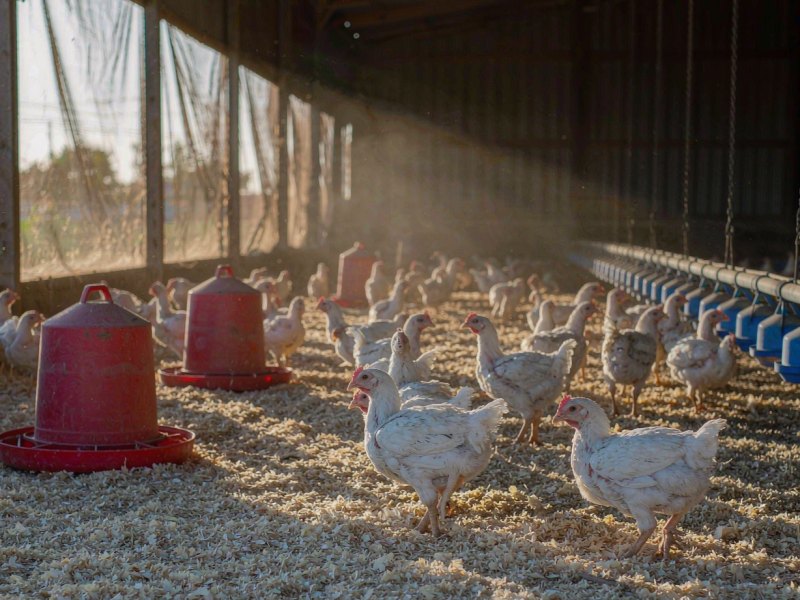
Walk into a broiler house in the late afternoon and your eyes will tell you more than any record sheet. If the air stings and you want to leave after two minutes, the flock is already breathing ammonia that costs money. Farmers ask how to reduce ammonia in a broiler house, and the honest answer rarely starts with a product. It starts with water.
Ammonia does not come from the feed bag. Uric acid in the droppings is split by urease into ammonia once litter moisture and temperature let bacterial activity run, and every extra point of moisture multiplies the release. Ammonia is really a water problem wearing a gas mask.
The thresholds are consistent across production manuals. Below 10 ppm birds show no measurable response. Between 10 and 25 ppm you see lower intake, poorer conversion and more wet droppings. Above 25 ppm growth falls sharply, the trachea becomes inflamed and the door opens for E. coli and respiratory viruses. Above 35 ppm eye damage appears. Your nose is a useful alarm but adapts within fifteen minutes, so measure rather than sniff.
Start with the drinkers. A line set too high, or a regulator set too low, spills water onto the litter under every nipple. Level the line as birds grow, keep pressure where a droplet hangs without running, and fit a drip tray. One leaking corner lifts local ammonia within two days.
Five to eight centimetres of dry, absorbent litter is enough, whether shavings, rice hulls or chopped straw kept dry in store. Deeper litter holds more water and is harder to keep aerobic. Aim for 25 to 30 per cent moisture. Squeeze a handful: it should clump loosely and your palm stay almost dry. Remove wet caked litter under the drinkers twice a week and top up with dry material the same day.
Minimum ventilation must continue even when outside air is hot and the house is wide open. Ammonia accumulates in still air. In open-sided houses, 0.5 to 1 metre per second at bird level dries the litter surface and carries gas out. In closed houses, never switch the minimum fans off at night to save fuel, because gas does not sleep.
Feed formulation has a direct line to ammonia. Every point of crude protein the bird does not need leaves as nitrogen in the droppings, so feeding 21 per cent to a flock that needs 19 per cent buys ammonia rather than growth. Balance digestible lysine, methionine, threonine and tryptophan first, then bring crude protein down to requirement. Phytase and a xylanase cut the undigested nutrients reaching the caeca, while probiotics and organic acids support gut integrity and reduce wet droppings, the cheapest ammonia control there is.
Wet litter is often the first visible sign of coccidiosis or necrotic enteritis, one to two weeks before mortality climbs. If litter under the drinkers stays wet while the rest is dry, look at the gut before the fans.
Keep three weekly measurements: ammonia at bird height in three fixed spots, litter moisture by the squeeze test, and footpad scores on fifty birds at catching. They move together, and any one drifting upward warns you before the flock does.
Where litter quality already limits performance, a mineral and amino acid balanced broiler premix with a gut health additive package removes part of the pressure before it reaches the floor. Our technical team will review your formulation and stocking density free of charge. Send the details on WhatsApp.