
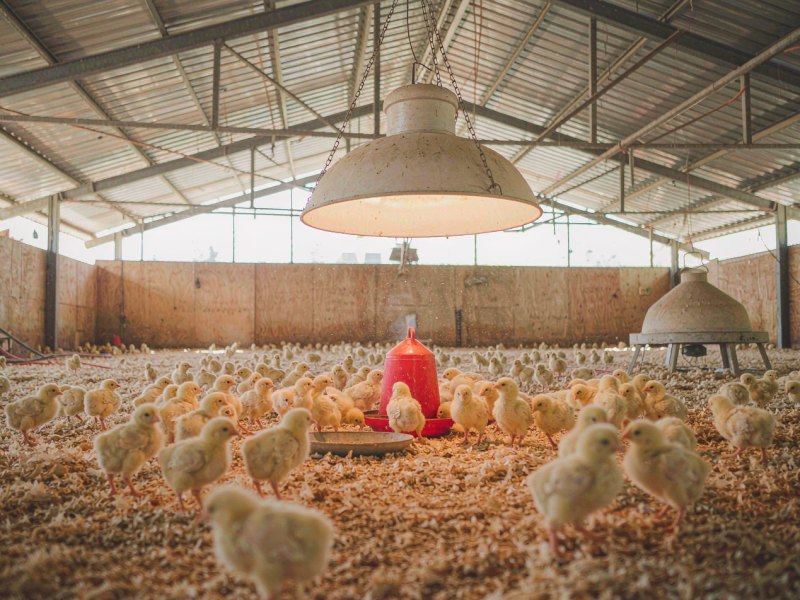
Ask a poultry farmer in Ghana or Cote d'Ivoire where his feed money was lost and he will usually point at the finishing phase. In practice, a large share of feed conversion is decided in the first seven days of the flock. A modern broiler hatches at about 40 grams and multiplies its weight several times before day 7, while its intestine and immune system are still under construction. When that week goes wrong — cold nights, dirty water, a first feed offered too late — the damage follows the bird to slaughter, even if the daily records afterwards look normal. So producers who ask how to reduce first-week mortality in broiler chicks are really asking how to protect feed conversion, because it is the same job.
Temperature is the first feed ingredient
Chicks cannot regulate their own body temperature for their first ten days. On day one they need roughly 33 to 35 degrees at chick level, dropping by about three degrees each week until the feathers take over. Thermometers help, but chick behaviour tells the truth faster: chicks spread evenly and quietly are comfortable, chicks huddled under the brooder are cold, and chicks pushed to the walls and panting are too hot. A habit borrowed from good hatcheries is to feel a sample of feet. Warm feet mean the chick has been comfortable. Cold feet mean it has been losing heat for hours, burning yolk energy it should have spent on gut growth.
Water first, then check the crop
A dehydrated chick will not eat, and a chick that does not eat in the first two days delays the development of its gut. Offer clean, cool water with electrolytes and vitamins during the first hours, and make sure every chick reaches a drinker within minutes on the litter. Then measure instead of guessing. Sample about one hundred chicks twelve hours after placement: four out of five should have a soft, full crop. By twenty-four hours it should be every chick you catch. A hard crop means the chick found feed but not enough water. An empty crop means feed or water was out of reach, or the house was too cold for the chick to move.
A starter feed that matches a gut under construction
The first crumbs a chick eats are not just calories — they train the gut. Offer fresh, good-quality starter crumb on paper or trays so feed is visible everywhere, topped up little and often rather than in one large fill. Because the skeleton, the immune organs and the intestinal villi all grow fastest in this phase, the starter needs well-balanced amino acids, calcium and phosphorus, and a complete vitamin and trace-mineral premix. Many farms also support the young gut with probiotics, organic acids and enzymes, which help digestion stay stable while the chick's own flora establishes. Poor early gut development returns later as uneven flocks, wet litter and a feed conversion you cannot recover.
Weigh at day 7, then act
Weigh one hundred chicks per house at day seven and compare with the hatchery standard. Weight on target with high uniformity confirms the whole first-week programme. Low weight with high uniformity usually points to temperature or feed quality. High weight with low uniformity points to late or unequal access to feed and water on the first day. One weighing, three different corrections.
For West African farms and feed mills, Jinmao Biotech supplies broiler starter premixes and gut-health additives designed for hot-climate conditions. For a starter programme matched to your farm, send us a message on WhatsApp with your flock size and current day-7 weights.