
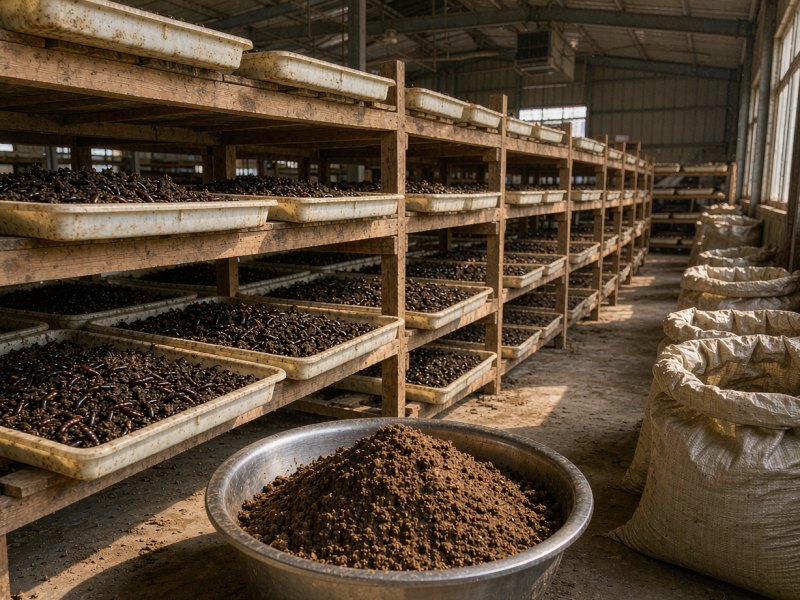
On 8 October 2026 the Agricultural and Social Entrepreneurship Foundation and Ignatius Ajuru University of Education in Port Harcourt signed a memorandum of understanding under a project called Waste4Meal. It sets out a demonstration farm that turns organic waste into insect protein using black soldier fly larvae, with the protein intended for poultry and aquaculture feed and the frass used as fertiliser. Students will work in the operation, and the promoters present it as a commercial pilot rather than a research bench.
The detail that matters for feed buyers is smaller than the headline. A memorandum does not supply a mill, and the report notes that certification and standardisation of insect based feeds by the Federal Ministry of Agriculture and Food Security are still needed before the material can trade at scale. Today insect meal is a niche ingredient with a promising trajectory, not a substitute you build a year of formulation on.
The economics explain the interest. World Bank data put soybean meal at 447 dollars per tonne in September 2026, up 24.9 per cent year on year, while maize reached 239.60 dollars. An ingredient grown on urban waste inside the region has obvious appeal where imported protein is paid for in foreign currency.
So can black soldier fly replace soybean meal in poultry feed? Partly, and only if the formulation is rebuilt around it rather than patched. Full fat larvae meal typically carries 35 to 45 per cent crude protein and 25 to 35 per cent fat, with calcium around 5 to 8 per cent and chitin near 5 to 8 per cent. Lysine sits at 2.2 to 2.5 per cent, and methionine remains the first limit, exactly as with soybean meal.
The fat is what catches people out. High fat meal oxidises quickly in tropical storage, and rancid fat depresses intake before any toxin does. Ask for the peroxide value and the production date, not only the protein figure. Defatted meal is more stable but costs more per kilo of protein.
Chitin is the second issue. Poultry cannot digest it, and at high inclusion it raises the viscosity of gut contents. Published work generally keeps larvae meal at 5 to 10 per cent in starter and 10 to 15 per cent in grower and finisher diets, with performance holding when amino acids are balanced on a digestible basis. Above that, weight gain and litter quality usually suffer together.
Substrate is the third. Larvae fed on fruit and vegetable waste carry a different risk profile from larvae fed on slaughterhouse or manure waste. Heavy metal and mycotoxin carry over depends almost entirely on what went into the bin, and the drying method decides whether the meal is microbiologically safe. A supplier who cannot name the substrate and the drying temperature is not yet a supplier.
For West African mills the sequence is short. Buy a small trial lot, send it for crude protein, fat, calcium, amino acid and peroxide analysis, run a single house comparison at 5 per cent inclusion against a control, and record intake, daily gain, conversion and litter condition for one cycle. If the numbers hold, negotiate a forward contract before the pilots become commercial and the price converges with fishmeal.
Jinmao Biotech supplies mineral and amino acid premixes and feed additives for poultry, cattle, sheep and pig producers across West Africa. If you are testing a new protein source and need the premix recalculated on a digestible amino acid basis, send your formula on WhatsApp and our technical team will return a revised specification.