
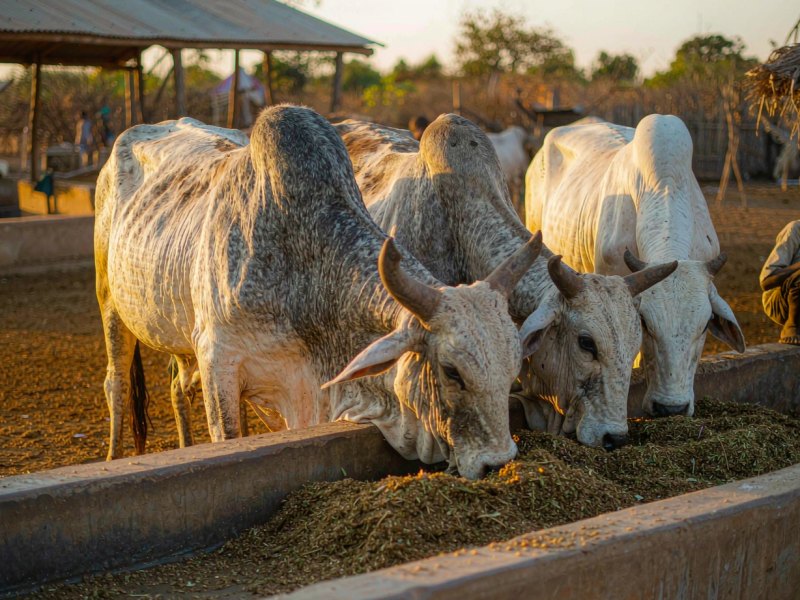
In a beef enterprise, most of the profit is decided in the last ninety days. An animal that reaches the market thin is discounted whatever the earlier feeding cost, and an animal kept too long eats margin that nobody pays for. Finishing is a short, planned phase, and the ration, the timing and the weighing all have to point at the same number. This is how to feed beef cattle for market weight without wasting a bag of concentrate.
Set the target before you buy a single ingredient. For the Zebu and Zebu crosses common across the Sahel and the coastal belt, a realistic finished weight is 350 to 450 kg live, with a dressing percentage of 48 to 52 percent and a daily gain of 0.9 to 1.2 kg in the final phase. Write the target weight and the sale date on the pen board. If the animal weighs 280 kg today and the market date is ninety days away, it needs 0.8 kg of gain a day, and that figure decides the ration.
Move the animal onto the finishing diet in steps, not overnight. Over two to three weeks, raise the concentrate from about 0.5 kg per head per day to 3 or 4 kg, keeping good roughage in front of the animal at all times. A sudden load of starch turns the rumen acid and the animal stops eating exactly when you need it to eat most.
At finishing, a workable structure is 50 to 60 percent roughage and 40 to 50 percent concentrate on a dry matter basis. Energy comes from maize, sorghum, millet bran and molasses. Crude protein of 12 to 14 percent is enough at this stage, because the frame is already built and extra protein is simply excreted. Cottonseed cake or groundnut cake covers the protein cheaply. Urea has a place, but never above about one percent of the ration and never without readily fermentable energy in the same mix.
Minerals are where cheap finishing rations fail quietly. A salt lick alone does not cover a finishing animal. It needs a proper finishing premix at 0.2 to 0.3 percent of the ration, supplying zinc, copper, manganese, selenium, iodine, cobalt and vitamins A, D3 and E. Keep calcium to phosphorus close to two to one and avoid over-liming the mix, because excess calcium locks up zinc and copper. In hot weather, or when concentrate is high, half a percent to one percent of sodium bicarbonate protects intake.
Water decides intake more than any formula. A finishing animal drinks 40 to 60 litres a day in the heat, and warm water in a black drum cuts consumption sharply. Clean the trough daily, give at least 60 cm of trough space per animal, and keep shade over the trough so the animal can drink without leaving cover.
Weigh monthly, or measure heart girth with a tape and convert. Guessing at weight is the most common reason a farmer sells at 300 kg believing the animal is at 380. At sale, aim for a body condition score of 3 to 3.5 out of 5, with fat over the ribs and around the tail head, because that is what local buyers actually handle before they name a price. Keeping an animal past 30 months costs feed and returns nothing.
If you are planning a finishing batch and want a premix built for high-concentrate rations, our team can match a specification to your local ingredients and your target weight. Message us on WhatsApp with your current ration and we will send back a comparison.