
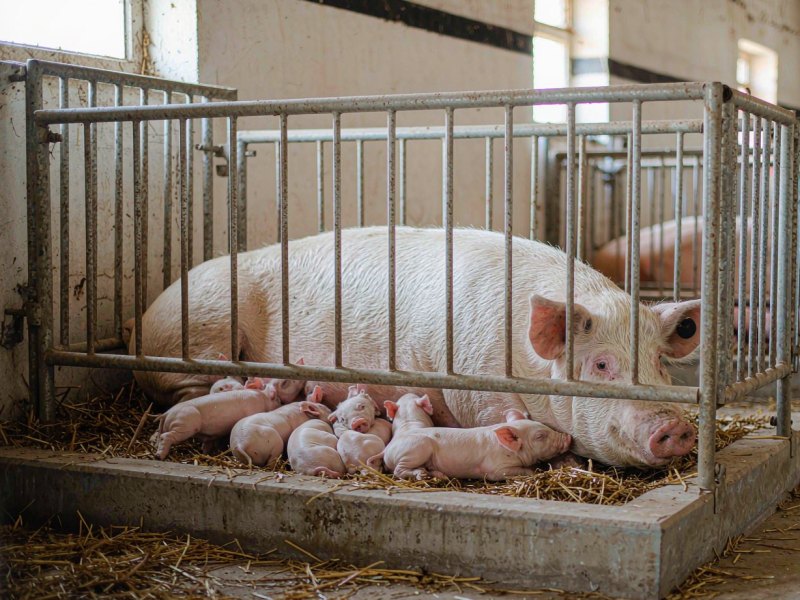
On most small and medium pig farms in West Africa, sows farrow whenever they farrow. A litter arrives on Monday, another on Thursday, a third two weeks later. The farrowing house is never empty, piglets of five different ages share the same air, and the feed store holds three formulas at once. Nothing is broken, but nothing is efficient either.
Batch farrowing replaces that continuous trickle with bands. Sows are grouped so that they are served, farrowed and weaned together, and the whole farm moves in steps instead of a daily stream. The most common interval is three weeks, because the sow's oestrous cycle is twenty-one days. One week of serving, three quiet weeks, one week of farrowing, then weaning, then the next service week.
The arithmetic is simple. Gestation runs about 115 days and a sow is usually back in service roughly 145 days after she was served, counting 25 days of lactation and five days to heat. Divided by a three-week interval, that is seven bands. A farm of 150 sows therefore farrows about twenty sows per band, enough to fill a small farrowing room without crowding it.
Getting sows into bands is the hard part, because you need control over the return to heat. Three tools do most of the work. Altrenogest holds gilts and sows for up to eighteen days and is best used once, to set the first cycle. PG600 brings weaned sows into heat when they show nothing by day six or seven. Culling removes the repeat breeders that fit no band at all.
The rewards arrive quickly. Pens can be emptied, washed, disinfected and dried for five to seven days between bands, which breaks the build-up of E. coli and coccidia that ruins so many weaning batches. Piglets inside a band are the same age, so creep feed, vaccination dates and weaning weights line up instead of overlapping.
Nutrition becomes easier to specify too. Gestating sows receive 2.0 to 2.2 kg of a gestation diet per day, with more for thin sows and for gilts still growing. Lactating sows go to full feed, often 5 to 6 kg per day, on a diet of 16 to 17 percent crude protein with 0.9 to 1.0 percent lysine. Piglets get creep feed from day seven to ten. A sow premix at 0.3 to 0.5 percent of the ration covers the trace minerals and vitamins that keep litters even and stillbirths low.
Three traps catch new users. Do not wean early just to make the calendar fit. Do not start banding without enough crates or pens for the peak week. And do not switch to grouped ordering with a supplier who cannot deliver the full tonnage in one drop, because a batch that arrives late is worse than no batch at all.
A farm that plans sows in bands also plans its feed, its labour and its cash. Instead of buying a little every week, you buy once a month in a quantity that earns a better price and a fixed formula that does not drift between deliveries.
Jinmao Biotech supplies sow, piglet and finishing premixes in 25 kg bags with documented specifications for farms and feed mills across West Africa. If you are moving to batch farrowing and want a premix matched to your band calendar, write to us on WhatsApp.